MIT Tests Magnetic Muscle Sensors for Prosthetics: What Three Participants Show
MIT scientists tested implanted magnetic muscle markers in three people with below-knee amputations. Here’s what the prosthetic-control experiment shows — and does not prove.
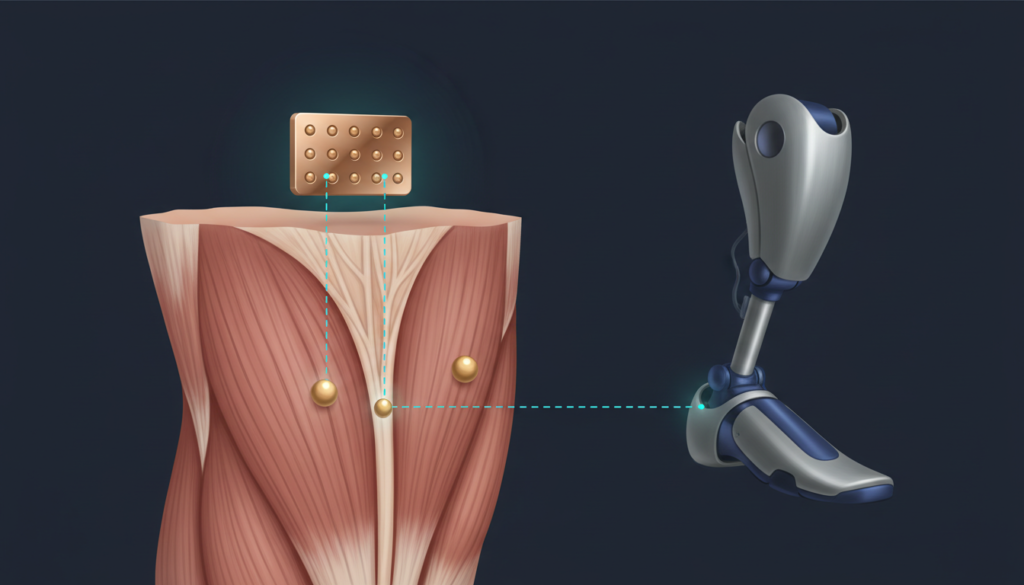
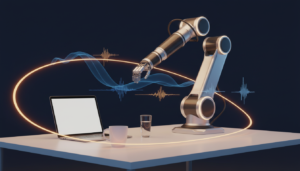
Original DeepTech conceptual illustration. Not a photograph of the participants, the MIT device, or a clinical outcome.
Researchers at the Massachusetts Institute of Technology have reported a new human study of magnetic muscle sensors for prosthetic control. The approach follows tiny implanted magnetic markers from outside the skin, allowing a computer to estimate how muscles move. Published on 29 October 2026 in Nature Sensors, the work involved three people with below-knee amputations. It offers evidence for a promising control interface, but it is not yet a demonstration of safer everyday walking with a commercial robotic leg. The distinction matters as implantable sensing moves from laboratory experiments toward practical assistive technology.
The peer-reviewed paper and MIT’s accompanying research report describe the system and its tests. Unlike many announcements about future medical devices, this project includes data from human participants, comparisons with established measurement methods and a public code repository. Those strengths are important; so are the restrictions of a three-participant study.
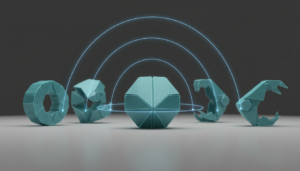
Featured image: original DeepTech conceptual illustration of magnetic markers and external sensing. It is not a photograph of the experimental device, a participant, or a clinical trial outcome.
The measurement problem behind robotic prosthetics
A robotic ankle or knee needs information about what the wearer intends to do. Conventional interfaces often rely on electromyography (EMG): electrodes detect electrical activity associated with muscle activation, and a controller translates that information into commands. EMG can be useful, but an electrical activation signal is not a direct measurement of how far a muscle has shortened or how rapidly it is changing length.
The distinction becomes relevant when estimating joint movement or forces. Electrical readings can change with the electrode position, movement artefacts or interference from nearby muscles. Surface measurements may also be sensitive to sweat and contact conditions. The MIT team has therefore investigated a different observation: the physical movement of the muscle itself. That does not mean EMG is obsolete; it means there is another signal worth comparing under controlled conditions.
How the magnetic markers are used
The method, known as magnetomicrometry, uses small implanted magnets whose relative positions change when the muscle contracts or stretches. A wearable sensor array positioned outside the body reads the resulting magnetic field. Software then estimates how those markers move, providing information related to muscle length and velocity without running signal wires from the implanted magnets to the external electronics.
According to the published study, the markers are approximately 3 millimetres in diameter, and the experimental platform tracks them at depths reaching up to 6 centimetres with sub-millimetre resolution in the evaluated conditions. These numbers describe the specific sensor platform and tests. They should not be interpreted as performance guarantees for every person’s anatomy or every future prosthesis.
The technique is wireless at the sensing stage, but placing the markers still requires an implantation procedure. The participants had previously undergone a particular form of amputation surgery that reconnects muscle pairs, and the team worked with clinical collaborators. Consequently, the results cannot be assumed to apply unchanged to all people with limb differences or all surgical histories.
What the three participants actually did
The human tests involved three participants with transtibial, or below-knee, amputations. The research team compared its magnetic method with measurements from implanted EMG electrodes and electrodes placed on the skin. These comparisons were designed to evaluate how effectively each information source could control a task relevant to movement of a future powered ankle-foot device.
During the reported trials, participants did not wear a new robotic leg while walking. Instead, they used muscle movements to move a cursor toward targets on a computer screen. The virtual task represented control variables that might later be used by a prosthetic controller. This design makes the sensor interfaces easier to compare, but it cannot establish real-world gait stability, fall risk, comfort during long use or performance outside the laboratory.
What the experiments found
In the published evaluation, estimates obtained from the magnetic platform matched or exceeded the surface and implanted EMG approaches on most of the outcomes the team assessed. The researchers also demonstrated detection of muscle activation using magnetic signals. That supports the case for additional testing, particularly when a control system needs stable information about changing muscle mechanics rather than electrical activity alone.
However, an outcome measured in a virtual cursor task is not equivalent to improved health or mobility. The sample was small, participants had particular clinical characteristics, and the comparison took place under defined experimental conditions. There is no basis in these results to claim that the interface already reduces falls, replaces established prostheses or works equally well for every user.
How auditable is the underlying research?
The study provides more than a news release. It has a DOI, peer-reviewed methodology, supplementary information and figure-level source data. The authors also make a public Python framework for magnet tracking available for examination. This provides a starting point for evaluating parts of the computational work without having to rely entirely on promotional claims.
There are limits to that transparency. The paper states that some additional human-participant data may be restricted by privacy and consent conditions, and not every software component is necessarily public. The existence of code and source data improves auditability; it does not establish that a separate laboratory has independently reproduced the complete clinical result. Our guide to independent technology validation explains why reproducibility and independent test conditions remain separate questions.
What would a practical prosthetic trial need to establish?
The most important next step is to test the complete sensing-and-control chain on functioning prosthetic limbs during real movements. A strong evaluation would include walking at different speeds, negotiating slopes and obstacles, daily use over longer periods, sensor reliability, comfort and clinically meaningful outcomes. It would also need to document adverse events, maintenance demands, magnetic interference and any risks related to implantation.
Performance should be reported by participant and task, not hidden behind a single success score. Predefined acceptance thresholds, adequate sample sizes and meaningful comparators would help determine whether better muscle-state estimates translate into better control. For context, our coverage of tactile sensing in robots also distinguishes successful sensor-assisted tasks from general claims of robust robotic capability.
The engineering opportunity and its limits
An external array that can track implanted markers may allow future wearable controllers to obtain richer information about muscle motion. That possibility is interesting for robotics, sensor manufacturing and rehabilitation engineering. The route to adoption, though, passes through clinical safety, regulatory assessment, everyday usability, costs and evidence that patients benefit from the complete system.
The researchers have reported that further work is assessing prosthetic limb control in a larger study. Until such results are available, the defensible conclusion is specific: three participants demonstrated a promising magnetic interface in controlled neuromuscular tasks. Claims about routine clinical use or superior real-world mobility would go beyond the evidence published on 29 October 2026.