Stanford–ISTA Photonic Chip Separates Mixed Light: What the Experiment Proves
A Stanford–ISTA photonic chip separated partially coherent light in two- and three-laser experiments. Here is what the peer-reviewed result proves, and what imaging applications still require.
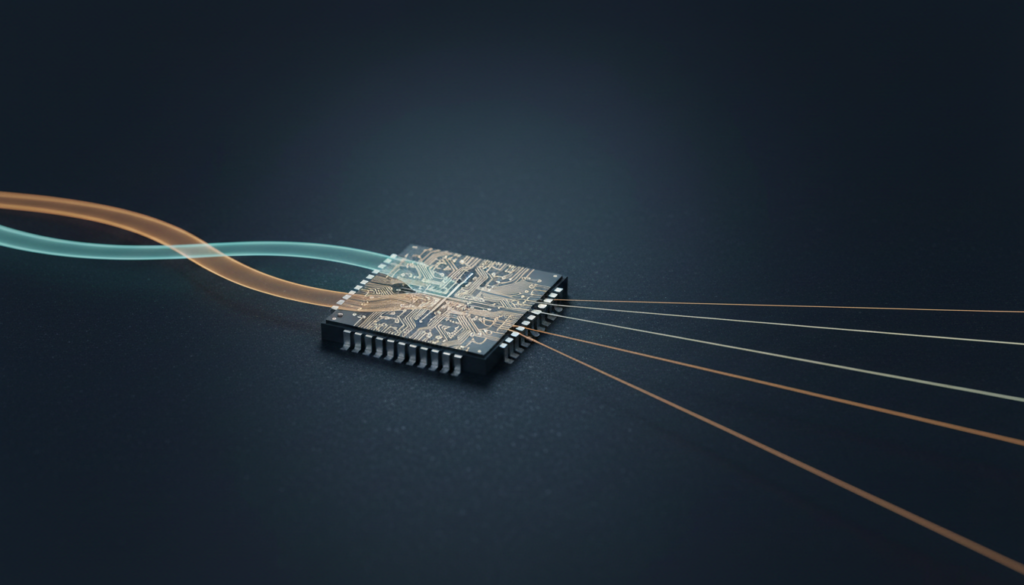
Original DeepTech conceptual illustration. Not a photograph of the Stanford–ISTA experiment or a measured optical result.
Researchers at Stanford University and the Institute of Science and Technology Austria (ISTA) have demonstrated a photonic chip that separates the distinct coherence components hidden inside mixed light. The laboratory result, published in Nature Photonics on 30 October 2026 and explained by Stanford on 2 November, points toward new ways to analyze optical signals. But the experiment should not be mistaken for an operational microscope or telescope with proven improvements in image quality.
The team tested a programmable optical circuit with light from two and then three infrared lasers. Rather than merely filtering colors, the system identified components distinguished by their statistical coherence and routed them into different outputs. The distinction matters: optical signals can overlap in ways that an ordinary camera cannot readily distinguish, even when the sources share a wavelength range. The original open-access research article and Stanford’s institutional account provide the primary record.
Image note: the featured image is an original DeepTech conceptual illustration of light entering a photonic chip. It is not a picture of the experimental hardware or a measured optical signal.
Why mixed light contains information a camera may miss
A camera generally records intensity at its sensor. That is extremely useful for making images, but it does not preserve every statistical relationship between the optical field arriving at different positions. When several sources contribute to the same image region, the detector can combine their intensities into a result that looks like one indistinct feature. Information about the light’s spatial coherence may survive in the incoming field even if it is not visible in the resulting image.
Coherence describes the degree to which optical fields maintain predictable relationships. Light from an idealized single laser mode is often highly coherent; light from an ordinary lamp is substantially less so. In practice, real optical fields can be partially coherent, meaning some relationships remain while others average away. Those relationships can carry clues about how many source components exist and how their spatial structure differs.
What the photonic chip actually does
Photonic integrated circuits guide and transform light within microscopic pathways on a substrate. They can serve as programmable optical processors rather than conventional electronic chips, using interference and phase adjustments to shape how light is distributed between ports. In this research, the chip was used to find a representation of an incoming partially coherent field in terms of distinct, mutually uncorrelated optical modes.
The article describes an automatic, adaptive separation of coherence modes. The processing system identifies the relevant optical patterns, and the photonic circuit steers them toward different outputs. A coherence mode is not necessarily the same thing as one physical object or one laser: it is a mathematical and optical component of the field. Conflating a mode with an independently identified astronomical object would overstate what the hardware has established.
An advantage of processing the field optically is that its components remain available as physical output beams for further analysis. A conventional measurement that collapses many features into one intensity image cannot necessarily recover them later. That is why researchers are interested in obtaining more information before an ordinary detector discards those distinctions.
What researchers demonstrated with two and three lasers
According to Stanford’s account, the team first combined infrared laser inputs to create a partially coherent field and sent that mixture through the chip. It then assessed the outputs using a separate optical arrangement that recombined the beams. The observed behavior supported the claim that the outputs were mutually incoherent in the tested setup: they did not exhibit the correlation expected of shared coherent components.
The experiment was repeated with three incoming sources, extending the demonstration beyond a two-component example. That is evidence that the programmable circuit can separate several coherence modes, rather than simply operating as a fixed two-port splitter. The published study gives the technical method and measurements behind the claim, while the institutional reports explain the broader implications for readers outside photonics.
These were controlled laboratory trials using selected optical inputs. The sources do not establish that the same device already operates in a working astronomical telescope, processes arbitrary outdoor lighting without calibration, or produces commercially useful biomedical images. The important achievement is the successful physical separation of partially coherent optical components under the conditions studied.
Why this differs from filtering colors or using a prism
A prism or wavelength filter separates light primarily according to spectral properties. Two light contributions at overlapping wavelengths may therefore remain mixed after conventional color-based separation. The Stanford–ISTA approach is directed at the spatial coherence structure of the field instead. That makes it relevant to situations where the desired distinction is not simply red versus blue light.
Neither approach replaces the other. Wavelength, polarization, timing and coherence can provide different views of the same scene. Future imaging systems might combine several measurements depending on the scientific question and the optical environment. The experiment establishes a new capability in one such measurement dimension, not a universal replacement for existing lenses, spectrometers or image sensors.
Could this reveal overlapping structures in microscopy?
The researchers discuss the possibility of using spatial coherence information to distinguish sources that contribute to the same visible region of a microscope image. For example, two fluorescent objects could appear blended in a conventional intensity image even when additional optical correlations contain evidence that more than one component exists. An instrument that preserves and analyzes those correlations could potentially help separate them.
That remains a proposed application, not a demonstrated clinical imaging system. A usable microscope would need adequate sensitivity, suitable illumination, controlled losses, compatibility with biological samples and clear improvements over alternative methods. Independent experiments would need to quantify resolution, signal-to-noise ratio, speed and reproducibility on realistic specimens.
Why astronomy is another research direction
Stanford also reported that members of the team are exploring a possible astronomy application with NASA. Light collected from a distant region may contain contributions from different celestial sources. Additional spatial coherence measurements could, in principle, complement the intensity information used by conventional imaging instruments.
However, astronomy imposes demanding requirements involving faint light, broad spectral bands, background noise, stability and precise calibration. Nothing in the two- and three-laser experiment proves that the chip already separates starlight from exoplanets or delivers a quantified improvement in an operational telescope. The collaboration is an avenue for investigation rather than a completed deployment.
What remains to be validated before commercialization?
The most useful next evidence would come from repeatable evaluations across a larger variety of optical fields, signal strengths and environmental conditions. Published tests should report separation accuracy, throughput, optical insertion loss, processing speed and how performance changes as the number of modes increases. Because this is a photonic processor, fabrication tolerances, thermal stability and packaging would also become relevant outside the laboratory.
A commercial device would need to outperform simpler alternatives on a clearly defined problem, not merely exhibit an interesting optical transformation. Independent replication of the reported measurements would strengthen the case for broader adoption. This is the same distinction between a laboratory demonstration and a reliable product discussed in DeepTech’s guide to evidence-led deep technology and our analysis of scaling advanced materials from research to manufacturing.
The research result in context
The experimental paper is titled Automatic on-chip separation of partially coherent light into its mutually incoherent components. It was written by an international team including Paul-Alexis Mor, Anne R. Kroo, Shanhui Fan, David A. B. Miller and Charles Roques-Carmes. Stanford and ISTA both published research summaries in early November 2026, after the peer-reviewed article appeared on 30 October.
The supported conclusion is concrete: a programmable chip separated selected mixed optical fields into distinct coherence outputs in controlled experiments involving two and three infrared laser sources. That is useful physical evidence for a new measurement tool. Future gains in microscopy, telescopes or communications are possibilities requiring additional application-specific verification, not performance results already demonstrated by this study.
Original sources and research record
- Nature Photonics — Automatic on-chip separation of partially coherent light into its mutually incoherent components (30 October 2026)
- Stanford University — Fingernail-sized chip untangles mixed light (2 November 2026)
- Institute of Science and Technology Austria — Splitting Light on a Chip (3 November 2026)