MIT Tests Nature-Inspired Metamaterials for Impact Absorption: What the Data Show
A Nature paper and MIT report describe variable-scale 3D-printed lattices tested in physical compression and impact experiments, with clear scaling limits.
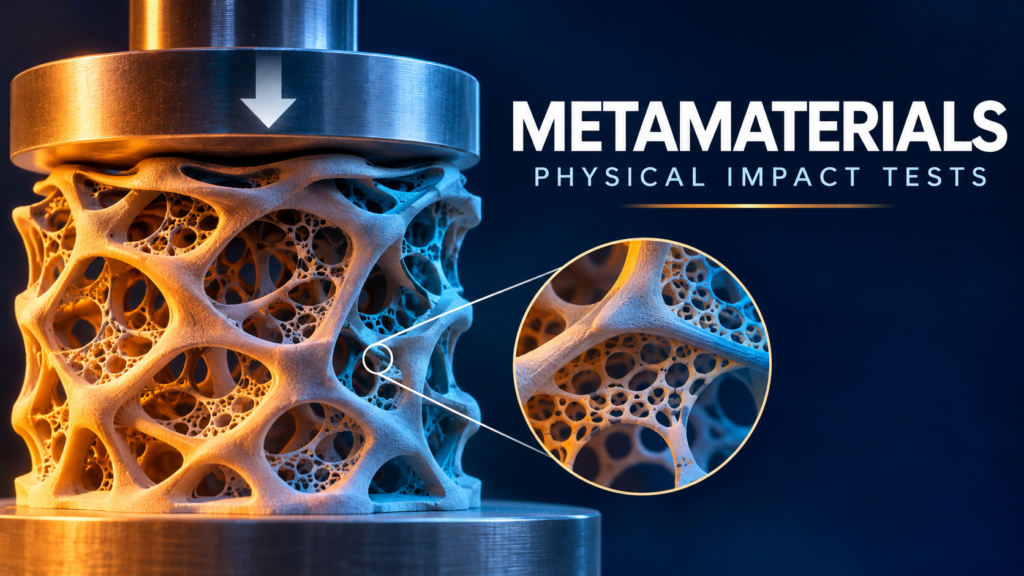
Original conceptual illustration for DeepTech. Not a photograph or measurement from the published experiment.
Does a perfectly repeating lattice always make the best impact-absorbing material? New research from MIT and Northeastern University suggests that carefully designed variability can be beneficial. In an open-access Nature study published on 11 November 2026, the team describes scale-rich network-based metamaterials built from elements of very different lengths, thicknesses and connectivity. Physical specimens were printed and subjected to compression and impact tests.
The result is not evidence that an entire commercial product is suddenly stronger. The underlying claim is narrower and more valuable: within tested laboratory geometries, changing network organization can tune stiffness and redistribute deformation, including under sudden loads.
From repeated unit cells to variable-scale networks
Many engineered lattices repeat a regular unit cell. This makes manufacturing and modeling simpler, but also constrains the possible deformation pathways. The Nature paper introduces networks in which beams vary across multiple scales. The architectural inspiration comes from complex networks, including biological structures, rather than from a single identical geometric element copied across the material.
The authors describe a design model with two principal controls for tuning network organization. This is not the same as a machine-learning model predicting an entire product’s future failure. The resulting geometry must still be fabricated, measured and tested. A paper design is a hypothesis about mechanical response until the physical material is made.
The experiment, not just the computer model
According to the peer-reviewed study, the team made centimeter-scale samples using vat-photopolymerization 3D printing and also explored smaller-scale fabrication. Compression tests examined how the structures behaved under loading, and a controlled impact apparatus tested their response to a sudden strike. The comparison included conventional square and hexagonal lattices and a Voronoi-style reference architecture.
MIT’s research announcement emphasizes how the new designs can reduce localized failure. The physical tests are particularly important because no numerical simulation can fully substitute for fracture patterns, manufacturing defects and nonlinear behavior under an actual impact.
What the 190-fold number means
The paper reports a 190-fold tunable range of elastic anisotropy across densities. That refers to how differently the material can respond depending on loading direction and selected architecture. It is not a claim that the material is 190 times stronger, lasts 190 times longer or absorbs 190 times more impact energy than every alternative.
The authors combine physical measurements with numerical work to characterize that tunability. Reporting the range without stating which property was tuned would mislead readers. This is why the headline of a high-quality engineering article should name the actual observable and the test conditions, rather than turning a large number into a generalized strength claim.
What happened under compression and impact?
During large-deformation tests, traditional reference lattices tended to concentrate deformation in local crush regions. The scale-rich designs displayed more distributed deformation. For dynamic experiments, the team used a controlled falling mass and measured peak force and energy dissipation. In the reported comparisons, the scale-rich specimens occupied a favorable region of high specific energy dissipation and relatively low peak force.
The paper also describes how material density, test orientation and specimen type influence results. The experimental impact comparisons were performed at specific laboratory settings, not under every possible speed, temperature or repeated-use scenario. The evidence supports the possibility of engineered impact absorbers, not a universal performance certification.
Why two kinds of measurement matter
- Peak force: a lower maximum load may reduce how abruptly an object experiences impact.
- Energy dissipation: a larger measured loss of impactor kinetic energy can indicate useful cushioning.
- Density and specimen mass: comparing structures at mismatched material quantities can distort claims.
- Deformation pattern: distributed versus localized crushing helps explain failure behavior.
- Repeatability: independent prints and impact tests are needed to assess production variability.
For a real protective enclosure or shipping component, those measurements must be combined with the target device’s specific safety standards and worst-case use conditions. A laboratory win against a set of reference geometries does not bypass those requirements.
Manufacturing and scaling limitations
The research relies on carefully designed 3D-printed networks. Industrial adoption would require evidence about print speed, defects, cost, post-processing, aging and performance after repeated loading. Larger parts may behave differently from small specimens. Production materials might also have different elasticity and fracture behavior than the laboratory resin used in the study.
An additional question is what happens when a network contains a damaged beam. Highly connected systems may spread stresses differently, but a real component needs measured tolerance to damage rather than an assumption of inherent robustness. Engineering teams should also evaluate inspection methods and methods for verifying that the printed geometry matches the intended design.
Why this matters to deep tech
The paper connects network theory to fabricated materials and measurable performance. That is the type of progress that can eventually support product development, provided manufacturing and qualification evidence follow. For context on a different effort to reduce physical material consumption through design, read our MIT fabric concrete beam test. Our broader Deep Tech guide explains why laboratory performance and commercial readiness must be assessed separately.
DeepTech has not replicated the compression or impact tests. This article differentiates peer-reviewed experimental observations, simulation-assisted analysis and future applications. We do not claim that a commercial helmet, packaging system or civil-engineering component has already passed certification on the basis of these samples.