Robot Tactile Sensing: Panasonic T-Rex Reaches 65% Across 12 Tasks
Panasonic’s T-Rex tactile robotics research reports 65% average success in 12 contact-heavy tasks. Here is what the result measures and what it does not prove.
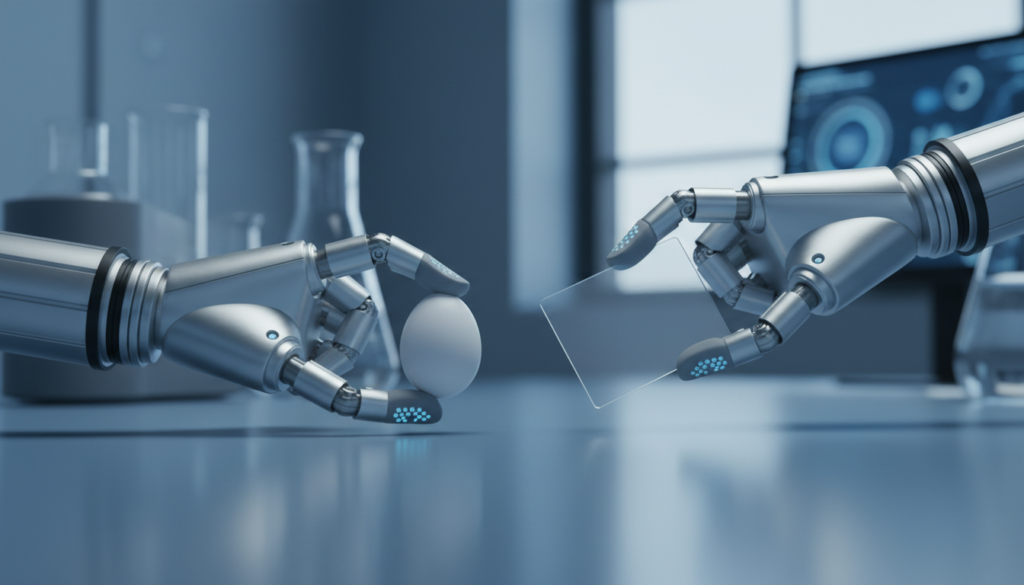
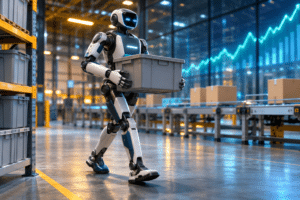
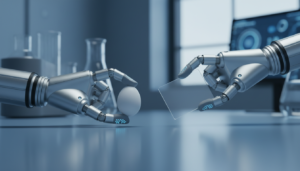
Original conceptual illustration for DeepTech; not a documentary photograph or screenshot.
Robot tactile sensing could help robots handle objects that require more than a camera and a pre-planned movement. On 5 November 2026, Panasonic announced results from T-Rex, a research system developed with university and industry collaborators for two-handed manipulation guided by fingertip feedback. In 12 real-world experimental tasks, the team reported an average success rate of 65%, against 35% for its strongest stated baseline. That is a substantial research result, but it is not evidence that a commercial robot can already perform every industrial task reliably.
What is different about this tactile robotics study?
A robot can visually identify a key, a page or a delicate object and still fail when contact occurs. It may press too hard, slide across a surface or lose its grip. Humans use touch to correct these errors almost instantly. The Panasonic-led project investigates whether a robot system can also use contact information while the action is happening, instead of relying solely on the next image or a previously generated instruction.
The researchers refer to the approach as Tactile-Reactive Dexterous Manipulation, or T-Rex. The announced collaboration includes Panasonic researchers, UC Berkeley, Stanford, NVIDIA, Sapienza University of Rome and other partners. The important issue for users is not the name of the system but its observable response: can tactile feedback improve completion of difficult physical tasks under stated test conditions?
What do the 65%, 35% and 42% figures actually measure?
According to Panasonic’s announcement, the 65% figure is an average across 12 selected manipulation tasks that demand attention to contact and force. The previously strongest comparison method reached 35%, and a version of the tested system without the tactile information reached 42%. These are results from the researchers’ reported experimental evaluation. They do not describe a field trial spanning factories, warehouses or household environments.
Examples in the evaluation included turning a page, moving an egg, applying toothpaste, unlocking a door with a key and removing a thin card. Such activities are informative precisely because small physical changes can turn a promising demonstration into a failed attempt. A 65% average also means there is considerable room for improvement before any claim of unsupervised, repeatable commercial operation.
Why are training data and test design important?
Panasonic reports a collection of more than 7,700 manipulation episodes, representing about 100 hours of robot manipulation data, involving multiple objects and action types. This helps explain the scope of the research effort; it does not turn the results into an independently verified industrial benchmark. Different objects, task definitions, repetition counts and failure criteria can all change measured performance.
To judge a robot for real deployment, an operator would also want per-task success rates, intervention frequency, damage to objects, time per action and recovery after unexpected contact. A single aggregate number can conceal both very easy and persistently difficult tasks. Reproducing a result outside the original research setting is a separate evidence step.
Where might robot tactile sensing matter first?
Manufacturing assembly, handling fragile goods and preparing mixed items in logistics are plausible applications because successful operation often depends on controlled contact. Panasonic says the research could eventually support these categories. That should be read as an intended application, not an announced product, delivery date or independent safety certification.
DeepTech’s earlier guide on humanoid robots at work explains why narrow experimental success should be separated from repeatable performance in an operating facility. The same distinction is essential here.
What evidence would make the next result stronger?
A useful next checkpoint would be a frozen evaluation on new objects, with a transparent definition of success, independently witnessed repetitions and a breakdown of failures. The progress reported by the research team deserves attention, but the question for deployment remains how often a machine completes a task safely when the circumstances are no longer chosen by its developers.
Primary sources
• Panasonic Holdings — official research announcement, 5 November 2026.
• T-Rex: Tactile-Reactive Dexterous Manipulation — research preprint.
Editorial note: The percentages and dataset figures are attributed to the researchers. The featured image is an original conceptual illustration, not a photograph of T-Rex hardware.