MIT FLEX Lets People Correct Robot Plans With Language: What Was Tested
MIT and NYU’s FLEX system uses natural-language corrections to change robot task features. We examine simulations, human evaluations and limits.
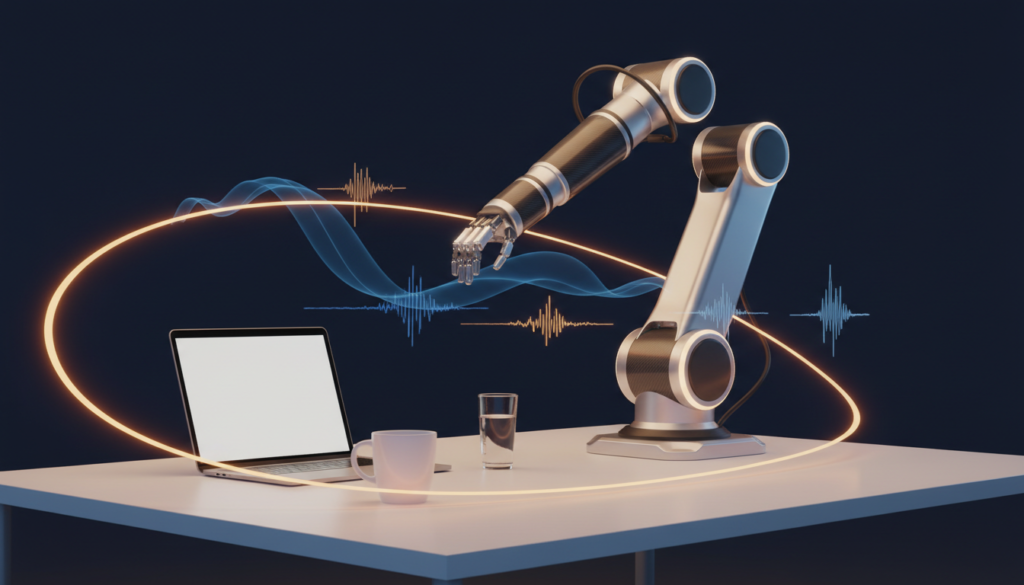
Original DeepTech conceptual illustration. Not a photograph or measured trial of the FLEX system.
A robot that follows a spoken instruction literally can still miss the user’s underlying intention. FLEX, a research platform from MIT and New York University, explores how a robot might treat natural-language feedback as a change in what matters for its task, rather than as a single narrow rule. MIT described the work on 9 November 2026, ahead of its presentation at the Conference on Robot Learning. The results are promising for more flexible robot planning, but they should not be mistaken for a fully autonomous household assistant ready for unsupervised deployment.
The study is titled Flexible Language-Guided Representation Editing for Adaptive Robot Behavior. It has a research project page with experimental results, an available research preprint, and a November MIT News account. Those original sources show a more limited and useful result than the phrase “robots understand common sense” might suggest.
Illustration note: the featured image is an original DeepTech concept drawing of a robot operating around fragile objects, not an experimental photograph or measurement from FLEX.
The problem with a growing list of robot rules
Consider a robot moving a cup across a kitchen counter. One person may tell it not to spill on a laptop; another may say to stay away from papers. A system that merely memorizes each named object can behave correctly at first, but it may keep adding special cases even when the same broader concern applies. Old rules can also remain active after a room or task has changed, making planning unnecessarily complicated or less reliable.
Robot motion planning must balance task goals with constraints that vary by user and environment. The challenge is identifying which features are important, and then avoiding irrelevant or redundant requirements. FLEX examines whether language corrections can help keep that representation compact and transferable, rather than adding one more exception at every interaction.
What the FLEX project actually evaluates
The researchers compare a pipeline of three operations: adding a missing task feature, generalizing a specific correction to a broader category and masking features that are no longer relevant. In a kitchen example, a laptop-specific instruction may indicate a broader concern about electronics. That is a task interpretation step, not proof that a robot has human understanding or moral judgment.
The experimental platform uses a language model as part of this representation-editing process. It also uses demonstrations to estimate the relative importance of task features. Crucially, the reported evaluation measures the system as a whole on defined planning tasks. It does not show that a language model independently guarantees safe actions in unbounded real-world environments.
What the simulation tests show
The project reports results in a two-dimensional navigation domain and a seven-degree-of-freedom Franka robot-arm manipulation domain. In the navigation benchmark, it evaluated seven combinations of feature-editing requirements. The full FLEX pipeline achieved the highest normalized reward in all seven according to the project page, while competing single-operation systems performed unevenly when tasks required multiple kinds of correction.
Normalized reward is a research metric defined for those scenarios; it is not a physical safety certification. A score close to one indicates high performance under the benchmark’s scoring rules, not that an industrial robot will always avoid collisions. Results can depend on the design of examples, demonstrations, evaluation metrics and what information the system receives.
Did people interact with a physical robot?
The project includes a human study involving natural language corrections and real-robot demonstrations, but participants viewed some robot behavior in simulation for safety during the comparative evaluation. The researchers also collected demonstration data using a physical Franka arm for offline learning. Therefore, a fair summary is that the evidence includes real human input and physical-robot data, while the central iterative comparisons were performed in controlled research setups.
This distinction avoids two opposite errors: describing everything as a computer-only toy experiment, or claiming a fully field-tested assistive robot. The researchers report favorable participant ratings on several measures, including task performance and perceived understanding of intent. Such ratings are informative within the study, but long-term deployment requires a different kind of evidence.
How much better was FLEX?
On the research page, the authors compare FLEX with an add-only method, a mask-focused method and a less structured language-model baseline. The table of seven navigation cases shows why flexible feature editing mattered in that benchmark: approaches optimized for one type of change often degraded when the user needed a different type. The team also reports statistical comparisons from participants’ ratings in the sequential robot-arm tasks.
These are researcher-reported comparisons. They do not support a claim that the system outperforms every other language-guided robot, nor that it has undergone independent safety validation. Task reward, user preference and system robustness are distinct measurements and should not be merged into one headline “success rate”.
What failure cases deserve attention?
A language correction can be ambiguous. For example, “keep away from fragile things” relies on recognizing both the object’s properties and the boundaries of the instruction. A system might classify an item incorrectly, generalize too broadly or suppress a constraint that remains important. Robust deployment therefore needs tests for changing scenes, conflicting instructions, unusual objects, sensor uncertainty and failures of the language component.
Safety-critical operation should not depend solely on the plausibility of a language interpretation. External collision monitoring, conservative fallback states, human oversight and logs of decisions can be evaluated independently of the dialogue interface. Our guide to independent AI evaluation explains why a frozen protocol and unseen scenarios strengthen evidence beyond a compelling demonstration.
Why this matters for practical robotics
As robots move beyond repetitive factory paths into variable human environments, users need ways to communicate preferences that were not anticipated by the original task designer. Language can be an efficient input for those changes, especially when the alternative is manually editing many task features. The engineering challenge is converting that flexibility into a measurable, reliable behavior-change process.
The work fits a broader research direction covered in our robotics coverage: progress is not defined only by what a robot can demonstrate once, but by how consistently it behaves under unfamiliar conditions. A practical FLEX-based system would need independent testing on physical tasks, diverse users, extended operation and clearly documented failures.
The measured result and the next question
FLEX supports a specific claim: within selected navigation, manipulation and human-interaction research tasks, editing the robot’s task representation through several language-guided operations led to better benchmark behavior than the tested alternatives. It does not establish general-purpose reasoning, fault-free language interpretation or readiness for unsupervised domestic assistance. The next useful test is whether those reported benefits transfer to independently assessed physical tasks with natural sensor noise and changing environments.