Explore difficult, real-world research questions through public scientific datasets. This is an independent editorial directory: each resource links to its original host, describes the evidence available, and makes clear what remains unsolved. The goal is to help readers and researchers find credible starting points—not to claim breakthroughs.
Six open scientific challenges
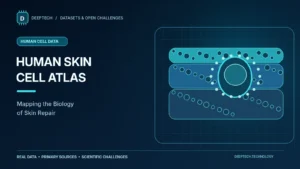
1. Human Skin Cell Atlas — understanding tissue repair
An integrated atlas of healthy human skin reports approximately 819,000 cells across 34 public source datasets, plus experimental spatial transcriptomics. The central challenge is to understand the organisation of skin cell types and their signals without confusing an atlas with a clinically validated regenerative treatment.
Official research data: GEO GSE308929 · Processed data objects (Zenodo).
2. SenNet — where do senescent cells appear?
The NIH-supported Cellular Senescence Network publishes datasets and tissue maps from human and model-organism research. Senescence varies by cell type, organ, age, health status and laboratory method. Detection is not equivalent to proving that removing those cells reverses ageing.
Official data portal: SenNet Data Portal.
3. Tabula Muris Senis — how cells change with age
Researchers measured single-cell gene expression across tissues and ages in mice. This is a genuine experimental animal dataset, not a simulation of human rejuvenation. It provides questions about tissue-specific ageing and methodological consistency.
Research resources: Tabula Muris Senis data explorer · GEO GSE149590.
4. ClinVar — resolving uncertainty in DNA interpretation
ClinVar is a public archive of submitted relationships between human genetic variants and diseases or drug responses. Some submissions disagree; a conflicting classification is not, by itself, evidence that any single laboratory is dishonest or that the variant’s true effect has been established.
Official data: ClinVar · Download formats and documentation.
5. GTEx — why gene activity differs among organs
Adult GTEx provides extensive measurements of gene expression and regulation across human tissues. Public summary resources are available, while individual-level raw sequencing and complete donor metadata require controlled access. Gene associations are not necessarily causes or treatments.
Official source: GTEx open-access downloads.
6. Human DNA evolution — five datasets to test open questions
Why does human chromosome 2 show an ancestral fusion, which DNA regions may influence neural development, how did the ABO system evolve, and what can ancient genomes reveal about lost populations? These are documented evolutionary research questions, not evidence of external genetic engineering. Our upcoming article on five real genomic datasets is scheduled for 25 November 2026.
Official data: UCSC comparative genomes · GEO HAR activity experiments · BrainSpan human brain data · 1000 Genomes/IGSR · Max Planck ancient Neanderthal DNA.
Our evidence checklist
- Was the dataset obtained from a documented experiment, observation or clinical source—or only generated through simulation?
- Who collected it, what population or specimens does it represent, and how were labels established?
- Are the data and usage terms open, restricted, or subject to ethical approval?
- What reproducible result would count as success, and what failure modes remain?
- What has been experimentally demonstrated, and what is still a scientific hypothesis?
No proprietary AION-62 results or internal mechanisms are disclosed here. Articles about these datasets are informational and do not constitute medical advice. Future analysis should require independently defined protocols and new, genuinely unseen data.
Forthcoming research articles
Six detailed research articles are scheduled to appear from 20 to 25 November 2026: the Human Skin Cell Atlas, SenNet, Tabula Muris Senis, ClinVar, GTEx and Human DNA Evolution. Until each article is published, the official repositories linked above remain the primary resources for inspecting the scientific evidence. This directory does not claim that DeepTech has independently reanalysed the datasets.
Last editorial source review: 15 November 2026.