Nature Battery Study Tests Four-Electron Iodine Chemistry Without Halogen Electrolytes
A peer-reviewed study reports multi-electron iodine conversion in water-based cells, including measured cycling retention; commercial battery readiness is unproven.
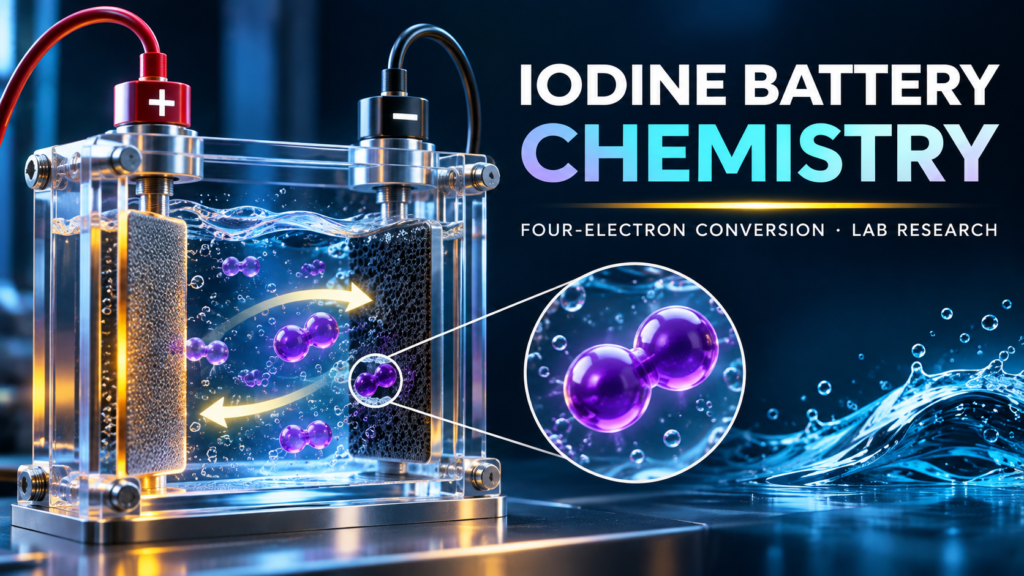
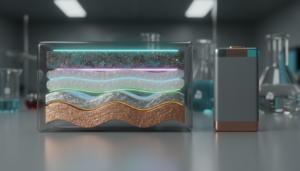
Original conceptual illustration for DeepTech; not an image from the experimental study.
A laboratory battery result is useful only when its chemistry, cell format and tested conditions are clear. A Nature paper published on 11 November 2026 reports experimental progress in aqueous metal–iodine batteries. The team describes an electrolyte approach that supports reversible four-electron iodine conversion without relying on highly concentrated halogen-containing electrolytes, a major problem in previous experimental designs.
This is not a commercially available battery and the findings do not establish the cost or life span of a full industrial installation. The scientific importance lies in demonstrated electrochemical reactions and measured cell cycling, with limitations documented by the researchers themselves.
Why water-based iodine chemistry is difficult
Aqueous batteries use water-based electrolytes, which can offer practical advantages for some stationary-storage concepts. Iodine-based positive electrodes can store charge through changes in oxidation state. However, the iodine species involved in higher-electron conversion can react with water, creating unwanted reactions and poor reversibility.
Earlier approaches stabilized reactive iodine species using concentrated electrolytes containing halogens such as chloride or bromide. The authors of the new peer-reviewed Nature paper investigate a different electrolyte chemistry combining selected anions with nucleophilic molecules. The goal is to control conditions near the electrode, where the conversion reactions occur, without relying on the older concentrated halogen-containing stabilization route.
What four-electron conversion really means
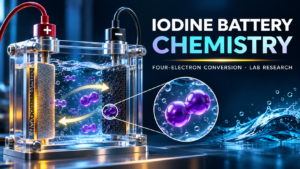
The paper distinguishes conventional two-electron iodine conversion from a multi-step process involving iodine states with more charge transfer. The quoted 422 mAh per gram theoretical iodine capacity is a stoichiometric property of the four-electron chemistry, not a measured energy density for a battery pack. It cannot be compared directly with the Wh/kg numbers of a lithium cell or a finished energy-storage system.
Real storage devices include inactive materials, collectors, separators, packaging and additional losses. Energy delivered over a specified operating voltage and tested mass must be measured independently before making a whole-cell or pack-level comparison. A larger theoretical active-material capacity is promising, but is not in itself a doubling of practical usable energy.
What was experimentally tested
The Nature team reports electrochemical measurements in zinc–iodine coin cells, with characterization of iodine chemistry by spectroscopy and other laboratory techniques. The electrolyte framework was also explored with several nucleophilic species, including urea, acetamide, pyridine and nicotinamide, and extended to aluminum–iodine configurations. These are different experimental setups and should not be treated as one uniformly verified commercial product.
In comparative tests, the combination of different electrolyte components enabled more reversible multi-step iodine conversion than specific control conditions. The authors also describe chemical characterization supporting their proposed explanation. Experimental observations and mechanistic modeling appear together in the paper; the measurements establish behavior under defined conditions, while interpretation of molecular mechanisms includes analytical and theoretical work.
Cycling figures: exactly what was reported
The publication reports that zinc–iodine cells retained about 96% of capacity after 1,000 cycles at 1 A/g and about 94% after 2,000 cycles at 2 A/g under the stated testing conditions. These are two conditions, not a promise that every cell will retain the same capacity under arbitrary temperatures, currents or duty cycles.
The study also examines higher iodine loadings, different current collectors and pouch-cell configurations. Such experiments broaden technical evidence but do not demonstrate long-term fleet reliability, full-system maintenance cost or compliance with commercial battery safety requirements. The researchers discuss iodine inventory loss and increased degradation at higher loading, which is important when interpreting apparent stability.
The limitations buyers should focus on
- Active-material metrics versus complete-cell and pack energy density
- Performance at commercially relevant electrode loading and realistic current profiles
- Cycle life under temperature fluctuations, rest periods and interrupted duty cycles
- Failure modes including iodine migration, side reactions and electrolyte degradation
- Bill of materials, manufacturability, handling and end-of-life processing
- Independent pilot testing with repeat cells and traceable test protocols
The paper includes a techno-economic analysis under modeled assumptions. This can indicate where a future cost advantage might lie, but it is not a verified quote for manufacturing, installed storage cost or lifetime cost per delivered kilowatt-hour. The financial case would require independently observed cell performance and realistic manufacturing and system-engineering inputs.
How this differs from the latest lithium battery stories
The new paper concerns aqueous zinc–iodine and aluminum–iodine chemistry. Our broader clean energy technology guide explains the different roles of storage technologies. The site also covers other storage advances separately; a high value in one experiment should never be presented as if its units, mass basis and conditions match another chemistry.
This distinction matters to utilities and manufacturers. Grid storage decisions depend on lifetime energy throughput, safety, siting, supply chain, reliability and integration, not one attractive laboratory number. A strong evaluation distinguishes theoretical possibility, experimental demonstration, repeated field validation and commercial readiness.
What the study establishes — and does not
The paper provides peer-reviewed evidence that selected water-based electrolyte compositions can support reversible four-electron iodine conversion and measurable cycling performance in laboratory configurations. It does not establish a guaranteed market-ready alternative to lithium-ion batteries or a verified large-scale stationary installation.
DeepTech has not built these cells or independently repeated the researchers’ experiments. Our guide to independent validation focuses on a related principle applicable across technologies: evidence should describe the precise test conditions and what remains untested. The next engineering milestone for these aqueous systems would be independent reproduction at realistic scale with comprehensive system-level metrics.