SenNet: Can Mapping Senescent Cells Guide Research Into Age-Related Disease?
What if some of the most important questions about ageing are not answered by a single gene, but by understanding which cells become senescent, where they are found, and what signals they release? The NIH-supported Cellu
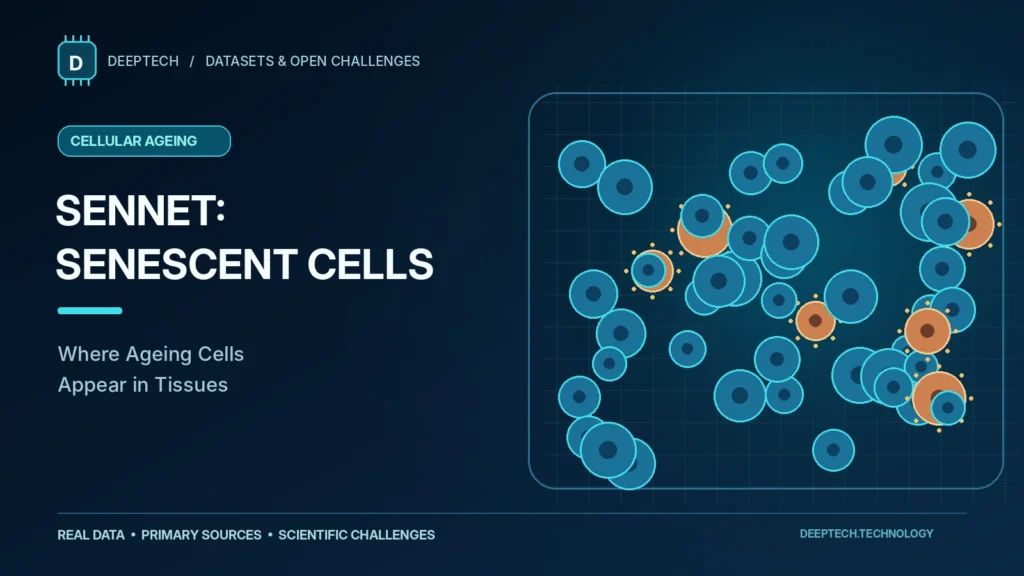
Original conceptual editorial illustration for DeepTech; not actual research data or experimental microscopy.
What if some of the most important questions about ageing are not answered by a single gene, but by understanding which cells become senescent, where they are found, and what signals they release? The NIH-supported Cellular Senescence Network, or SenNet, has created a public research resource for that investigation.
What counts as evidence of a senescent cell?
Senescence is not measured by a single universal marker. Depending on tissue and method, researchers may inspect cell-cycle arrest, stress-related gene expression, secreted proteins or other indicators. A cell with an elevated marker is not necessarily senescent in every biological context, and a cell without one selected marker cannot automatically be labelled healthy. This is why the NIH SenNet programme focuses on multimodal mapping, shared data resources and contextual information.
SenNet should also not be mistaken for one standardised clinical trial. The portal links datasets from different experimental teams, tissue types and technologies. Before combining them, a researcher has to check which materials came from humans, which came from model organisms, and whether the measurements identify the same underlying property.
Why senescent cells matter
Cellular senescence describes a range of biological states associated with changes in cell division, stress responses and signalling. Senescent cells can appear in tissue development, injury responses, disease and ageing. They are not one uniform category: properties can differ substantially by organ, species and experimental setting.
One important reason researchers study these cells is their secreted signalling molecules, which may influence neighbouring cells and inflammation. Understanding their context is relevant to investigating age-related disease, tissue function and regenerative responses.
What SenNet provides
According to the official NIH SenNet data portal, the programme was created to identify and characterise differences in senescent cells across the body, stages of life and states of human health. Its datasets include experimentally measured human and model-organism tissues and are combined with cell atlases and analytical tools.
That makes SenNet a structured source of biological observations, rather than a computer simulation claiming to reproduce human ageing. Individual datasets still differ in measurement methods, sample populations, access terms and technical quality.
The link to future treatments
Senescence research includes the possibility of developing interventions that modulate harmful senescent-cell behaviours. Mapping where those cells occur and which molecules they release can inform target selection and help researchers distinguish potentially useful responses from pathological ones.
A relevant experimental paper in Nature, Senescence atlas reveals an aged-like inflamed niche that blunts muscle regeneration, describes senescent cells in damaged mouse muscle and links their inflammatory niche to regeneration. Its findings are meaningful laboratory evidence, but they do not show that a therapy reverses whole-body human ageing.
Open challenges for reproducible research
- Can senescent-cell categories be distinguished consistently across tissues?
- Which markers remain robust across independent laboratories and technologies?
- Are changes linked to disease state or to normal biological context?
- Does an association predict a measurable tissue response in a new experiment?
- Which source records and uncertainty values are essential for auditing a claim?
Official research sources and limitations
Start with the NIH SenNet Data Portal and its project metadata. For a peer-reviewed experiment relating senescent cells to muscle regeneration, see the Nature research article.
Prospective therapies must be tested through appropriate experimental and clinical pathways. No SenNet cell map alone establishes a cure for ageing or any associated disease. The intended value is a more reliable foundation for biological investigation.
See additional datasets in our open-challenges directory.
An auditable study design for senescence research
A useful analysis would select one defined tissue and a fixed dataset release, then document the marker criteria before inspecting outcomes. A second laboratory or data collection should be held back for evaluation. The primary result could be marker reproducibility, agreement with an independently measured senescence-associated characteristic or consistency of spatial localisation. It should not be presented as a measurement of longer lifespan without an actual longevity study.
- Biological context: separate age, disease, injury and tissue location rather than treating all senescent cells as interchangeable
- Reference labels: report whether an annotation rests on multiple markers, a functional experiment or a computational classification
- Batch effects: document laboratory and sequencing differences before claiming a cross-tissue signature
- Future interventions: test cellular consequences experimentally before proposing benefit or safety in people
The point of a public atlas is to prioritise sharper questions. It cannot establish that removing a cell state is beneficial in every tissue, or that a biological intervention has reversed ageing in humans. No new intervention has been tested by DeepTech in preparing this article.