Magnetic Origami Robot Crawls, Rolls and Grasps: What Was Physically Tested
A peer-reviewed magnetic origami robot study reports actual locomotion and grasping experiments; the results are not evidence of autonomous field deployment.
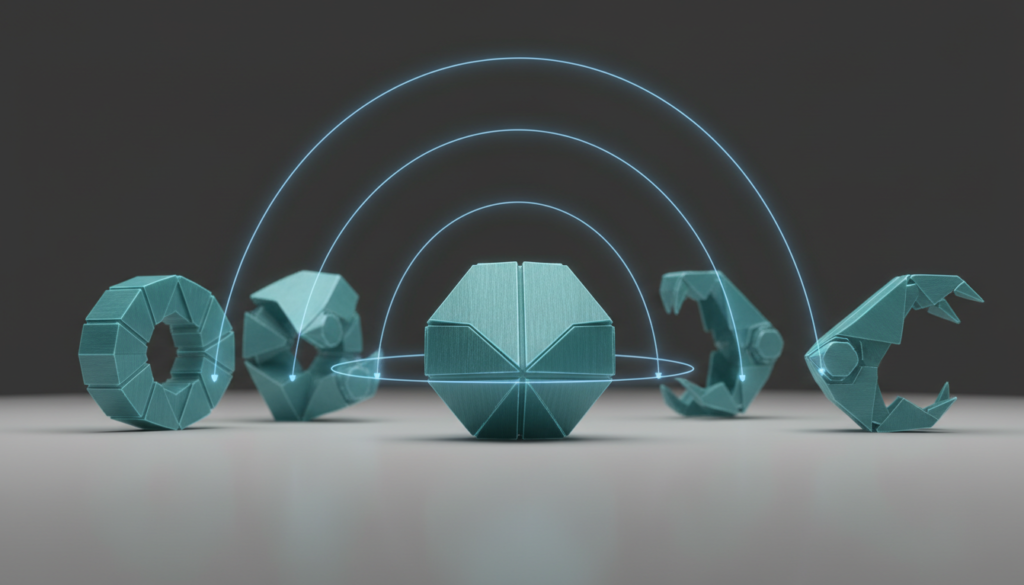
Original conceptual illustration generated for DeepTech; not a photograph or image of the reported experiment.
Small robots controlled by magnets usually face a difficult trade-off: producing the desired motion requires careful control of a magnetic field, yet keeping that field uniform over a large working area is challenging. A peer-reviewed paper published in Nature Communications on 6 November 2026 demonstrates a different physical prototype: an origami-inspired robot with two stable structural configurations, controlled using deliberately nonuniform magnetic fields.
This is a report about an experimental device, not merely a software simulation. The researchers demonstrate several kinds of movement and object interaction. However, the article does not establish an autonomous general-purpose robot ready to work outside a laboratory or a clinically validated device.
What makes this origami robot different?
Traditional magnetic actuation setups seek precise field patterns to command a robot’s pose. The team behind the published study instead designed an origami structure that has two mechanically stable states. The geometry itself influences how the device deforms when a magnetic disturbance is applied. The basic architectural idea is to shift some of the control burden from external field uniformity to the physical behavior of the folded structure.
A small perturbation can produce a deformation associated with a selected stable configuration. A larger impulsive magnetic input can switch the configuration or trigger a more abrupt action such as grasping. The distinction matters: the same device can express different mechanical behaviors without changing into a completely different platform.
Which movements were demonstrated?
The paper explicitly reports self-grasping, object capture and locomotion including crawling, turning, tumbling, scampering, jumping and rolling. Its actuation system operates over a larger workspace with low-uniformity magnetic fields, which is the central physical challenge the authors are trying to address.
These verbs describe demonstrations under the researchers’ experimental conditions. They should not be translated into unverified claims about speed in an industrial factory, obstacle avoidance in an unknown room or reliable manipulation of delicate objects. For instance, performing a controlled grasp does not establish a quantified success rate across many unseen object shapes.
Why physical experiments matter
Robotics research often reports impressive animations but leaves a gap between digital motion planning and real actuation. In this case, a fabricated structure and magnetic control apparatus form the basis of the reported demonstrations. That makes it possible to study real deformation, actuation responses and interactions with objects rather than relying solely on a physics engine.
Even so, the relevant level of evidence is laboratory demonstration. The open-access paper documents research methods and includes supporting materials. Readers should distinguish an actual prototype from field verification, independent reproduction and mass manufacturing validation. Each layer answers a different engineering question.
What should a robotics buyer ask before adopting the concept?
- Field conditions: what magnetic field strength and spatial variation are needed over the working area?
- Repeatability: how consistently does each movement or grasp succeed across independent trials?
- Payload: what sizes, masses and materials can the device capture without failure?
- Control: can a system handle disturbances and obstacles without a carefully staged environment?
- Endurance: how does the folded material behave after repeated switching and impacts?
- Safety: how are surrounding electronics, sensitive equipment and nearby people protected?
These questions should be tested on actual hardware. Software demonstrations can support design, but cannot replace measurements of response variability, material wear, control latency or operational safety.
Potential applications without jumping ahead of the evidence
The reported combination of locomotion and manipulation is relevant to compact robots operating in constrained areas, where large external actuators are impractical. Research opportunities include adaptable inspection and object-handling mechanisms. Those are plausible engineering directions, not products or commercially proven use cases documented in the study.
Magnetic devices also raise scaling questions. A setup that works on one bench may need a different field source, tracking arrangement and calibration scheme in a larger or cluttered environment. Supplying larger magnetic fields is not automatically more efficient or safer; the required boundary conditions should be part of any practical evaluation.
How this differs from language-based robot planning
A separate MIT research project covered in our article on FLEX robot planning corrections addresses a different challenge: adapting robot plans in response to human language. The origami paper concerns physical embodiment and magnetic actuation. A capable robot ultimately needs both dependable physical control and an appropriate task-level control policy, but success in one dimension does not prove success in the other.
For a broader view of engineering claims and deployment hurdles, see Humanoid Robots at Work: Real Uses and Remaining Limits. The technologies differ dramatically, yet share the need for transparent physical testing and well-defined operational boundaries.
What remains unverified
DeepTech has not independently operated the robot, examined raw trial-by-trial outcomes or reproduced the magnetic apparatus. The study describes experimentally demonstrated modes under controlled conditions, not a field-tested system that can travel or manipulate objects without supervision. No general industrial reliability percentage should be inferred from the named motion repertoire.
The research is noteworthy because it presents a tangible route to multiple physical motions using a bistable design and less restrictive field uniformity. Its next meaningful step is repetition across hardware units and new environments, with standardized measures of control accuracy, success, endurance and failure modes.