IBM Links Two Quantum Chips With Four Long-Range Couplers: What 99% Means
IBM reported four long-range couplers linking two Nighthawk processors, with 99% state-transfer fidelity but lower remote gate fidelity. We check the evidence.
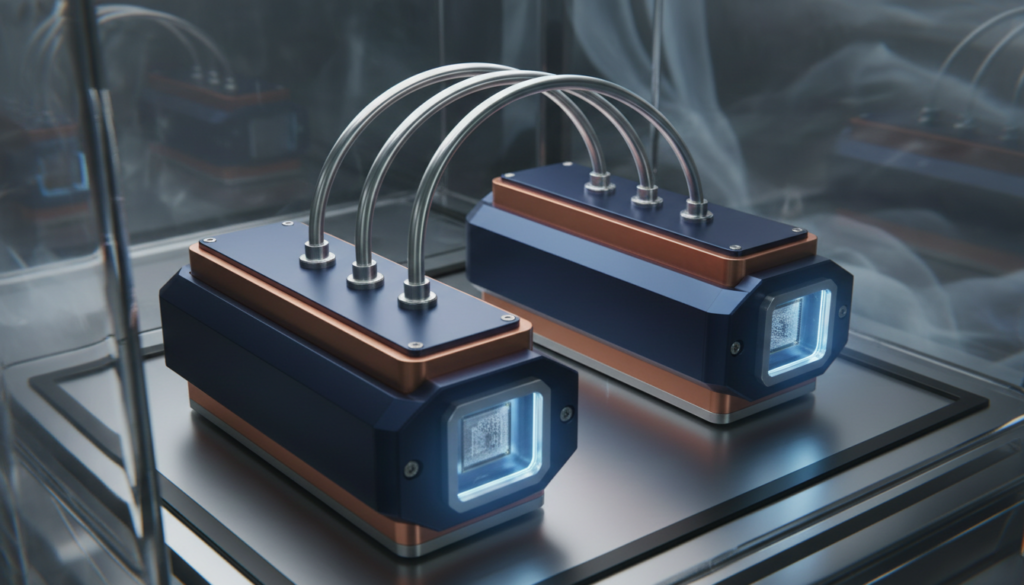
Original DeepTech conceptual illustration. Not a photograph of IBM quantum processors or an experimental fidelity chart.
Connecting separate quantum processors is becoming an important engineering question as quantum hardware grows beyond the practical limits of a single chip. In a research update published 27 October 2026, IBM reported four long-range superconducting links between two Nighthawk R1 processors. Its most striking figure is an average 99% quantum state-transfer fidelity across those links. That number describes a particular transfer benchmark: it is not a 99% success rate for a complete quantum computer or a guarantee of fault-tolerant computation.
The result is described in IBM’s technical account and a publicly available research preprint titled “Meter-scale quantum interconnects between large quantum processors”. The preprint was posted in October 2026; it should not be presented as independently peer-reviewed merely because IBM has announced it. The experimental numbers and their limitations are what matter.
Image disclosure: DeepTech’s featured illustration is a conceptual visualization of linked cryogenic modules, not a photograph of IBM hardware or a measurement plot.
Why modular quantum processors are interesting
Superconducting quantum computers must maintain carefully controlled conditions while applying operations to qubits. Building all desired qubits on one chip creates difficulties in wiring, manufacturing yield, device calibration and reliable interactions between distant components. A modular design would connect multiple processors, potentially allowing a system to grow without treating a single large chip as the only scaling route.
However, modularity introduces a new challenge: quantum information must cross a physical connection with sufficiently low error for useful operations. A cable that is effective at carrying ordinary classical data is not automatically suitable for preserving delicate quantum states. This is why link quality is a research metric separate from the familiar number of qubits on each processor.
What hardware was actually connected?
The experiments joined two IBM Quantum Nighthawk R1 processors, each built as a 120-qubit processor, through four connections called l-couplers. Each link used approximately 80 centimetres of superconducting aluminium coaxial cable, along with interface elements on the chips. The chips themselves were full Nighthawk processors, but IBM says only a subset of qubits was wired out for the development tests.
The architecture supports connections after processor modules are mounted inside a dilution refrigerator. That is important for packaging and serviceability in future modular systems. Still, the presence of two large processors in one experiment does not mean their entire qubit arrays have been combined into one production-scale processor with all operations and error correction already demonstrated.
What does the 99% figure measure?
IBM reports a 99.00% mean fidelity for transferring quantum states through the four tested links, with the strongest individual link reported at approximately 99.3%. Fidelity estimates how closely a measured process matches the intended ideal operation under the defined benchmarking method. It is not equivalent to an error-free link, and repeated operations can accumulate additional errors.
The distinction becomes especially important because moving a state is not the same task as executing a complete two-qubit gate across the connection. The team’s remote controlled-Z (CZ) gates achieved an average fidelity of 94.75% across four links. That lower figure describes a more demanding operation and is essential context for evaluating the engineering milestone. Reporting only the higher transfer result would mislead readers about the quality of all available operations.
Did the experiment demonstrate entanglement?
Yes, the preprint reports creation of entangled states shared between the two modules and a demonstration using two links simultaneously to generate independent entangled pairs. These are significant laboratory checks because an interconnect intended for quantum computing must support more than transport of classical signals.
But the experiment does not show a general fault-tolerant quantum algorithm operating across many modules, nor a complete large-scale error-corrected computation. Entanglement distribution, remote gate operations and robust logical computation are different levels of system capability. Our earlier report on quantum error-correction testbeds explains why hardware integration and correction performance need separate evaluation.
What evidence makes the result assessable?
The research preprint contains experimental setup information, descriptions of the links, benchmarking procedures and performance metrics. IBM also reports that the link modes attained quality factors on the order of 106, relevant to retaining microwave quantum information. These reported measurements offer more substance than a high-level product roadmap alone.
Even so, an independent assessment would require access to comparable hardware, repeatable calibration procedures, uncertainty estimates and full records of failed as well as successful operations. Yield across manufactured devices, performance over time, system-level noise and the effect of adding many more links are not settled by the four-link demonstration.
How does this differ from IBM’s Chicago announcement?
IBM’s separate November announcement concerns a Quantum System Two installation in Chicago. The l-coupler study is a different research result: it investigates processor-to-processor connections inside a cryogenic environment. One is a deployed system milestone; the other is a laboratory demonstration of a particular interconnect approach. Combining them into one claim about operational modular fault tolerance would be inaccurate.
For context, our article on IBM Quantum System Two in Chicago covers the system deployment, while this report focuses strictly on the inter-chip link’s measured performance and outstanding limitations.
What needs to happen next?
For a modular architecture to become broadly useful, the connections need reproducible manufacturing, stable calibration and better gate fidelity at higher scale. Engineers would need to characterize errors when many links operate simultaneously and establish how error-correction codes behave on qubits distributed over separate processors. The full cost of cryogenic packaging, interconnection and control would also matter in a real system.
The reported milestone is concrete: four long-range links between two superconducting processors delivered high state-transfer fidelity and lower, but measurable, remote gate fidelity in IBM’s experiments. It is evidence toward modular quantum hardware, not the achievement of a completed fault-tolerant quantum computer.