
Humanoid Robots at Work: Real Uses and Remaining Limits
Humanoid robots at work are moving beyond demonstrations. Explore industrial uses, safety limits, human oversight and the evidence behind deployment claims.
Updated: 5 November 2026.
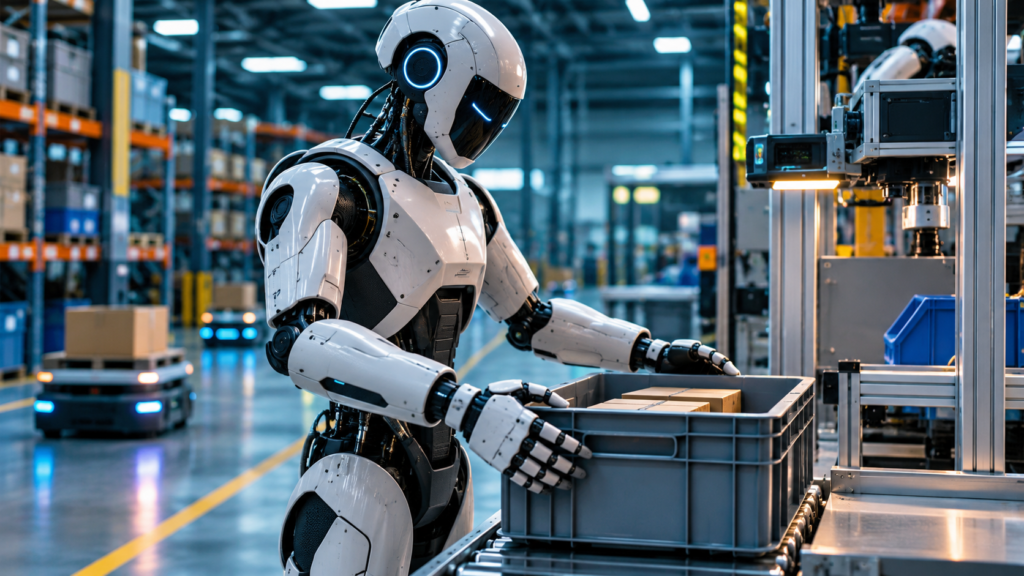
Humanoid robots at work are being evaluated for tasks in workplaces built for people. A humanoid robot has a body designed with some human-like features, often including arms and legs. The shape may allow it to use spaces built for people, but looking human does not mean it can perform every human task or operate safely in any environment.
Warehouse work as an early use case
Warehouses provide tasks that can sometimes be defined more narrowly than household work. In 2024, Agility Robotics announced a multi-year agreement with logistics company GXO involving its Digit robot, following a proof of concept. This is a company announcement about a specific commercial arrangement, not proof of widespread deployment in homes.
Moving a container from one place to another still requires the robot and its operators to handle balance, object position, changing layouts and the safety of people nearby. A successful demonstration of one workflow should not be mistaken for general-purpose competence.
Why the home is harder
A home contains clutter, fragile objects, pets, stairs and unpredictable human activity. A robot must recognise objects, manipulate them without damage and behave safely when circumstances change. Battery life, maintenance, price and the amount of human supervision are practical questions as important as an impressive video.
Learning and evaluation
Researchers are developing AI models to help robots interpret instructions and act in physical environments. Progress should be measured through repeatable tests: which tasks were attempted, how often they succeeded, what support was needed and how failures were handled.
Humanoid robots may find useful roles in selected settings, but their real value will depend on safe, reliable work over time. For now, distinguish a controlled demonstration, a pilot and a broad commercial deployment.
Sources and further reading
- Agility Robotics: GXO agreement announcement (2024)
- Google DeepMind: Gemini Robotics research announcement
Warehouse demonstrations are not home deployment
A structured warehouse offers known routes, defined tasks, trained supervisors and repeatable object handling. A family home presents different flooring, lighting, pets, furniture and unpredictable human movements. A result from one location should not be presented as evidence that a robot can perform unrelated tasks safely elsewhere.
Commercial readiness should be assessed with time-on-task, intervention frequency, operational availability, safe recovery after errors and total maintenance costs. These measures reveal more than a short video of a successful action. They also make it possible to compare robots against existing non-humanoid equipment for the same task.
Related research: how researchers are addressing uncertain robot memory and the safety limits of autonomous drones.