IBM Quantum System Two Opens in Chicago: What Nighthawk r2 Actually Changes
IBM Quantum System Two is now operating in Chicago with Nighthawk r2. Here is what the 120-qubit deployment establishes, what researchers plan to test and what remains unproven.

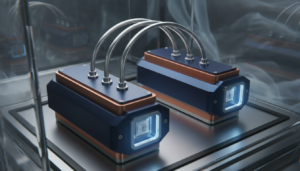
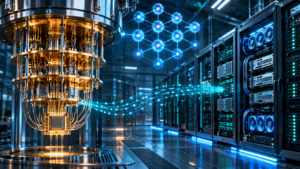
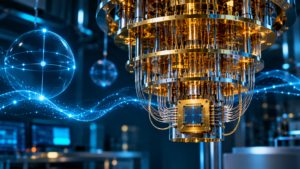
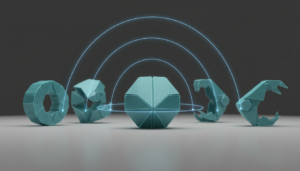
Original DeepTech editorial illustration. Not a photograph of IBM Quantum System Two or the Chicago installation.
A new IBM Quantum System Two in Chicago is now operating at the University of Chicago’s Hyde Park Labs, bringing IBM’s Nighthawk r2 quantum processor into a regional research center. Unveiled on 6 November 2026, the installation is IBM’s first quantum computer in Illinois. It is a working research facility, not an announcement of a general-purpose quantum computer that has surpassed classical machines on every task. IBM’s announcement and the University of Chicago’s report confirm the deployment.
The more important story is how the system will be used: as shared infrastructure for quantum algorithm development, alongside conventional computing, universities, laboratories and industrial partners. The practical value will depend on the experiments it supports and the results those teams can reproduce.
Editorial image note: the featured image is an original DeepTech concept illustration, not a photograph of the Chicago installation.
Where is the IBM Quantum System Two installed?
The machine is initially housed at Hyde Park Labs in Chicago, a research and entrepreneurship building near the University of Chicago. It sits at street level behind windows, making a normally hidden class of scientific infrastructure visible to passersby. Its long-term destination is the Illinois Quantum and Microelectronics Park (IQMP), which is still being developed.
IBM describes the installation as an anchor of the National Quantum Algorithm Center (NQAC), a collaboration launched in 2024. The center is intended to connect academic researchers, companies and laboratories. A physical deployment matters here because it can support local work on operating hardware, even though public access conditions and experimental schedules have not been independently established in the announcements.
What does Nighthawk r2 add to the system?
The Chicago installation uses IBM Quantum Nighthawk r2, according to IBM’s technical account of the deployment. The processor has 120 programmable physical qubits and a square-lattice arrangement with 218 tunable couplers. These couplers provide connections between neighboring qubits for implementing quantum operations; they are not another 218 qubits.
IBM says Nighthawk r2 adds a high-speed qubit reset architecture, supporting throughput of more than 100,000 circuits per second in its reported operating conditions. Its published comparison describes up to 25 times the circuit throughput of IBM’s Heron systems. That is a hardware throughput comparison, not a claim that every quantum algorithm becomes 25 times faster. Experimental runtime also depends on circuit structure, preparation, measurement and error-handling costs. See IBM’s Nighthawk r2 technical explanation.
Why the 120-qubit number is not the whole story
Quantum processors should not be compared with ordinary CPUs by counting qubits as though they were interchangeable with classical cores. Device quality, circuit connectivity, execution speed, calibration and noise can determine whether a workload is feasible. More connections can reduce the routing overhead of some circuits, but they cannot remove physical error mechanisms.
Nor are 120 physical qubits equivalent to 120 fully protected logical qubits. Building reliable logical operations requires quantum error correction, additional physical resources and careful classical decoding. The distinction is especially relevant because IBM, Oak Ridge National Laboratory and AMD also recently announced a separate quantum error-correction co-design initiative. That initiative and the Chicago deployment are related parts of a wider research ecosystem, but they are not the same experiment.
What work is planned in Chicago?
IBM and its partners identify several research directions, including molecular simulation for drug discovery, power-grid optimization and work in fundamental physics. The announcement describes NQAC Grand Challenge participants such as AbbVie, Deloitte, EPRI and university teams, while national laboratories including Fermilab are part of the wider Illinois collaborations.
These are prospective or ongoing research programs, not proof that quantum computers already deliver routine commercial savings in pharmaceutical development or electricity networks. To judge real progress, researchers will need disclosed workloads, meaningful classical comparisons, error and uncertainty measurements, repeatable results and the cost of running each computation.
Does this prove quantum advantage or fault tolerance?
No. Operating a quantum system is an engineering milestone; quantum advantage is a claim about a particular problem and an appropriate classical benchmark. Fault tolerance is a separate question about controlling errors over sufficiently long computations. IBM and University of Chicago researchers have reported earlier quantum-advantage work, but that is not evidence that this newly installed Chicago machine has independently demonstrated fault-tolerant operation. Our guide to quantum advantage and error correction explains the difference.
The deployment does provide a concrete opportunity for researchers to investigate these questions on current hardware. Strong future evidence would include clearly specified circuits, versions of hardware and software, calibration context, statistical uncertainty and independent replication where feasible.
What to watch next
For Chicago, the next meaningful milestones are the algorithms tested by NQAC partners, published comparisons against strong classical methods, transparent error metrics and whether results carry across devices or repeated runs. The eventual move to IQMP will be an infrastructure change, not automatically a performance breakthrough.
The confirmed achievement is specific: IBM Quantum System Two, powered by Nighthawk r2, is operating at Hyde Park Labs as a platform for collaborative quantum research. The harder claims—reliable advantage on useful problems, economic value and scalable error-corrected computation—still require evidence beyond an opening ceremony.