Google Genie 4 World Model: Interactive AI Worlds and Their Real Limits
Google DeepMind unveiled Genie 4 with interactive world simulation and native audio. Its research preview also has limits in physics, consistency and access.
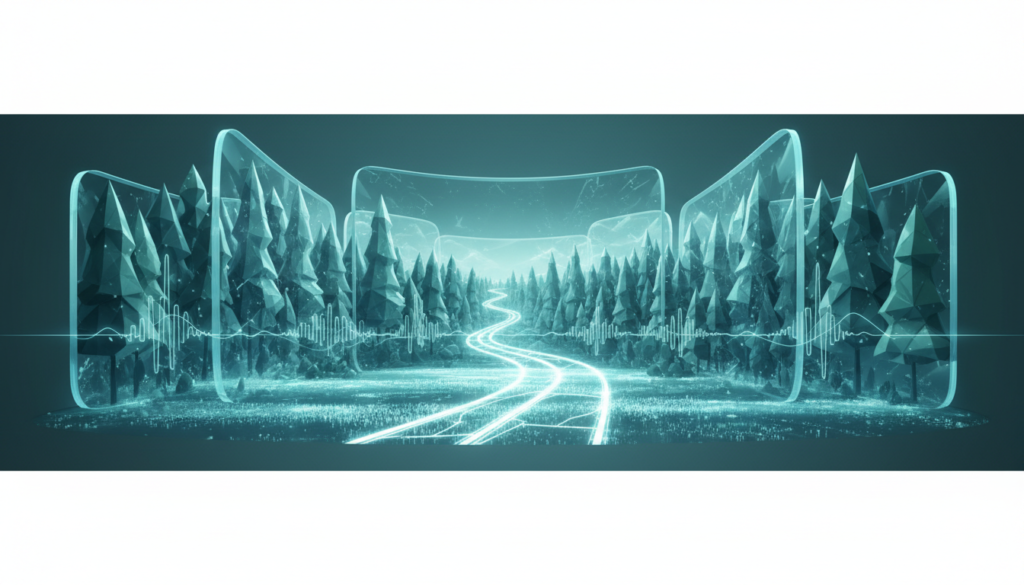
Original conceptual illustration for DeepTech; not a documentary photograph or screenshot.
The Google Genie 4 world model is a research preview designed to generate interactive environments that respond to a user’s choices in real time. In its announcement of 27 October 2026, Google DeepMind showed examples involving scenery changes, moving characters and sound produced as the virtual world evolves. The technology offers an intriguing route toward training environments for robots and AI agents, but the company also lists limits in physical accuracy, consistency and session length.
What does the Google Genie 4 world model do?
Rather than producing only a static image or a finished video, the model creates an environment a person can explore and influence. Demonstrations show a user navigating with controls while prompting the system to modify the weather, introduce a character or alter the scene. Sound is generated alongside the experience, including ambient noises and conversational interactions. This is simulation generated by AI, not a live camera feed from the real world.
The system is linked to other models in Google’s Gemini family. DeepMind describes a division of work in which some components help maintain coherence or interpret changing instructions while Genie creates the audiovisual environment. For readers, the observable question is straightforward: can a generated world remain consistent after the user makes repeated changes?
Why might interactive world simulation matter for robotics?
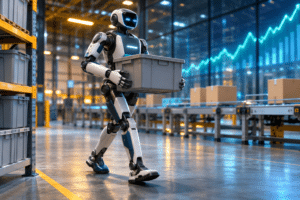
Robot research often needs many different situations before hardware can be evaluated safely. Virtual worlds could help researchers design scenarios, rehearse tasks and find obvious failures without moving physical machines for every trial. They may also support games, education and creative production when rapid prototyping is more important than exact correspondence to the physical world.
However, a convincing virtual obstacle or object collision is not proof that the underlying simulation predicts a real robot’s contact forces, sensors or failure rates accurately. A system trained in a generated world still needs a controlled transfer test before any performance claim in a factory, warehouse or public setting.
What are the admitted limits of Genie 4?
Google says visual details and object permanence can drift over time, particularly after several complex modifications or longer interactions. The company also identifies spatial precision, complex physical interactions, accurate audio, legible text and long-term consistency as active research problems. The model is designed for a few minutes of continuous interaction rather than indefinitely stable environments.
These limitations matter because a scene that looks credible may change unnoticed between steps. If a simulation is used to evaluate a robot or an autonomous agent, researchers must test whether crucial objects, boundaries and physical conditions remain reliable. Otherwise, apparent success could reflect quirks of the generated environment rather than real-world competence.
Can anyone use Genie 4 now?
As of the 27 October announcement, Genie 4 was being rolled out as a research preview to a limited group of trusted testers. Google stated that broader access was planned beginning with Google AI Ultra subscribers through Project Genie and with selected API and AI Studio partners. This means the announcement should not be described as a generally available public product for all developers.
How should the next tests be reported?
A rigorous evaluation would record the initial prompt, controls used, duration, scene modifications, observable failures and reproducibility across runs. For robotics, the key external evidence would be whether planning or training based on the simulation actually improves outcomes on independent physical tasks. Neither impressive visuals nor vendor demonstrations alone can answer that question.
DeepTech’s guide to independent AI validation describes why researchers should distinguish a promising demonstration from evidence that holds up outside its original test setting.
The broader significance
Interactive world models could expand the ways developers explore hypothetical situations. Yet fidelity is not the same as realism: a model can create a vivid environment that is still inaccurate in ways that matter. Genie 4 is therefore best understood as a research milestone with meaningful possibilities and openly acknowledged shortcomings, rather than a ready replacement for physical testing.
Primary sources
• Google DeepMind — Genie 4 research announcement, 27 October 2026.
• Google DeepMind — Genie model overview and limitations.
Editorial note: Availability and capability claims are attributed to Google. Featured image is an original conceptual illustration, not a screenshot produced by Genie 4.