Quantum Error Correction: IBM, ORNL and AMD’s New Testbed
IBM, Oak Ridge and AMD launched a quantum error correction testbed. See why GPUs matter, what was announced and what still needs independent testing.
Research and industry analysis · 5 November 2026. This article reports a new research platform, not a demonstrated error-free quantum computer. Its performance has not been independently tested by DeepTech.
Quantum error correction may ultimately depend as much on conventional computing as on quantum processors. On 5 November 2026, IBM, Oak Ridge National Laboratory’s Quantum Science Center and AMD announced a research platform that brings quantum hardware and high-performance classical computers into a shared environment. The central idea is practical: diagnosing and responding to quantum errors requires fast computation outside the quantum chip itself.
The announcement is significant because it connects two engineering problems that are often discussed separately: protecting fragile quantum information and moving the necessary classical calculations quickly enough to support a larger quantum system. It does not mean the companies have already delivered a fully fault-tolerant machine.
What IBM, Oak Ridge and AMD announced
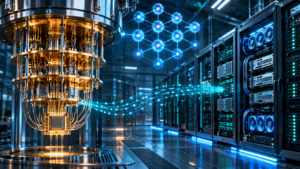
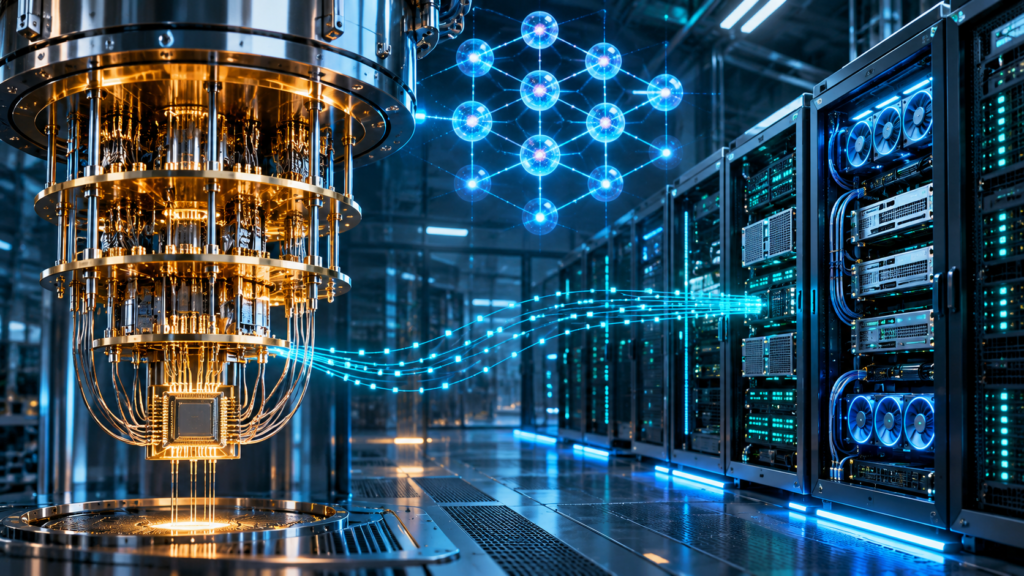
The new co-design platform is located at IBM’s site in Poughkeepsie, New York. It brings IBM Quantum Nighthawk processors together with Umbra, a high-performance computing system associated with Oak Ridge’s Quantum Science Center. The classical resources include AMD Instinct MI355X graphics processors and fifth-generation AMD EPYC processors, according to IBM’s announcement.
Researchers will use the combined environment to investigate quantum error correction, decoding, timing and the interaction between quantum processors and conventional computing resources. The physical proximity is intended to reduce hand-off delays and remove some of the infrastructure work that individual research teams would otherwise need to assemble.
This is a research capability and an engineering collaboration. The published announcement describes equipment, intended experiments and a development direction; it does not provide an independently verified benchmark proving that a complete application now runs error-free.
Quantum error correction needs classical computing
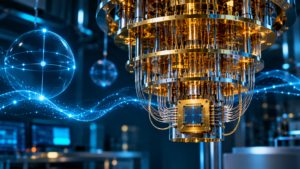
A quantum computer represents and processes information using qubits. Physical qubits are sensitive to noise, imperfect operations and measurement errors. Quantum error correction aims to preserve useful information by distributing it across larger sets of physical components and repeatedly checking for signs of faults.
Those checks produce information that must be interpreted. A conventional computer evaluates the measurement data and helps determine whether a correction or a change in the control sequence is needed. This classical task is commonly called decoding. For some experiments, the timing of that work matters because the quantum processor cannot simply wait indefinitely for an external decision.
That is why this announcement is not just about a faster quantum chip. It is also about GPUs, CPUs, connections and software working together under real experimental constraints. A useful platform must balance quantum execution, decoding resources and the time spent moving information between the two.
Why the hybrid quantum computing approach matters
Think of the problem as a demanding control loop rather than a contest between two processors. A quantum device performs operations and generates measurements; a classical system analyses the observations; the combined workflow then determines what happens next. Improving one component may achieve little if the overall process is limited elsewhere.
For example, a powerful decoder is less valuable when moving measurement data to it adds excessive delay. Similarly, colocating hardware does not guarantee that the software can make efficient use of it. The relevant result is how well the complete experiment behaves, not just the maximum speed printed on a GPU specification sheet.
This is an editorial interpretation of the system-level challenge, not a claim that DeepTech measured the new platform. It is precisely the kind of question the partners say they intend to investigate.
Nighthawk, Umbra and the limits of the announcement
IBM identifies its Nighthawk processor family as the quantum side of the platform, with its quantum blog describing Nighthawk r2 hardware for this work. Umbra supplies classical resources. The technical roles are complementary: quantum devices execute quantum circuits, while conventional computing supports decoding, analysis and orchestration.
The distinction between physical qubits and logical qubits is essential. A count of physical qubits refers to available hardware components; logical qubits are encoded units designed for greater protection. They are not interchangeable statistics, and a figure quoted for one experiment should not automatically be attributed to another processor or setup.
The U.S. Department of Energy’s stated late-2028 research target includes 100 logical qubits performing 100,000 difficult operations. That is a goal, not a milestone achieved by the newly announced platform. IBM also discusses longer-term fault-tolerant quantum computing plans, which should be understood as plans rather than guaranteed delivery dates.
Five measurements that would make the results auditable
A useful next step would be to publish independent, reproducible comparisons under fixed experimental conditions. In DeepTech’s proposed evaluation framework, the most informative measurements would be:
- Logical error rates: How often does encoded information fail as experiments become longer or more complex?
- Decoder latency: How much time elapses between obtaining measurements and producing the classical response?
- End-to-end throughput: How many useful experimental operations finish within a defined period, including classical work?
- Resource requirements: How much quantum hardware, GPU capacity, energy and communication bandwidth are used?
- Failure conditions: Which workloads or operating conditions cause the combined system to miss a deadline or produce unreliable results?
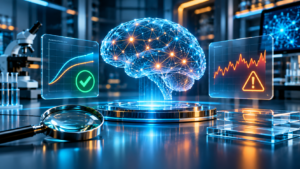
These are proposed verification questions, not measurements published by DeepTech or a claim that IBM has already reported all five. Evaluation would also need stated datasets or workloads, frozen software versions, uncertainty intervals and enough experimental detail for others to inspect the comparison.
What this development does not prove
The launch does not show that quantum computers have replaced high-performance classical computing. In fact, it demonstrates continued dependence on classical components. Nor does the location of two machines in one facility, by itself, demonstrate a specific speedup, commercial advantage or safety guarantee.
The underlying collaboration may make future experiments faster or more systematic. Whether it improves practical quantum calculations will depend on measured results, reproducibility and comparisons with credible alternatives. That is the gap between announcing a capable research environment and validating its impact.
The DeepTech perspective
The most useful insight in this story is not a promotional claim about the future. It is a shift in the question researchers are trying to answer. Instead of looking only at what a quantum chip can do in isolation, the new platform is designed to study the performance of a combined quantum-and-classical computing workflow.
For readers evaluating quantum computing news, this provides a practical rule: look for results measured across the entire system, with clear distinctions between demonstrated performance, engineering intentions and future targets.
Related reading: our guide to quantum advantage and error correction and independent technology validation.
Verification sources
- IBM Quantum research briefing, 5 November 2026 — platform specifications, research objectives and the stated 2028 target.
- IBM’s official announcement, 5 November 2026 — participating organisations and initial deployment.