
MIT Fabric Concrete Beam Uses 67% Less Concrete — What the Test Shows
MIT and BU engineers cast a 3-metre concrete beam with substantially less material using sewn fabric molds. The limited load test and cost comparisons reveal the promise and caveats.
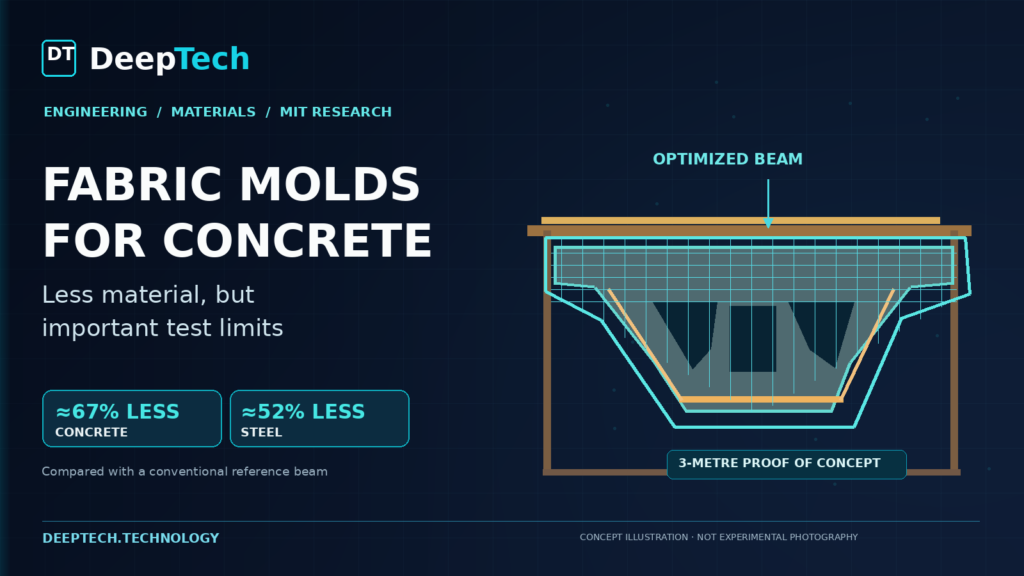
Original DeepTech concept illustration based on reported MIT research figures. Not a photograph or technical drawing of the tested beam.
A research team at MIT and Boston University has demonstrated a 3-metre concrete beam cast inside a sewn fabric mold, using substantially less material than a conventional reference beam designed for the same loading conditions. The reported prototype used approximately 67.2% less concrete and 52% less steel reinforcement. Those savings are significant for an experimental design, but they do not yet establish that it can replace ordinary structural beams in completed buildings. MIT published the research summary on 6 November 2026; details of the underlying study are available from the Shape DeCo research laboratory.
The story matters because structural optimization and practical fabrication are often two different challenges. Computer software may identify a material-efficient shape, but producing that shape using specialized robotic or milled formwork can make it uneconomic. The experiment investigated whether comparatively simple textiles could close that gap.
Image note: the featured artwork is an original DeepTech conceptual diagram, not a photograph or engineering drawing of the tested beam.
What makes a fabric concrete mold different?
Standard reinforced-concrete beams are commonly poured into rigid molds that retain rectangular or other straightforward cross-sections. A beam shaped around how forces flow can need material in some regions and relatively little in others. The resulting geometry can be awkward to produce with ordinary timber panels.
In the MIT-led work, the researchers combined graphic statics, used to organize the reinforcing steel, with topology optimization to distribute concrete where it contributes to the structure. A digital patterning process then translated the geometry into flat pieces of fabric. Once stitched and supported by a simple frame, the textile became a temporary form into which concrete could be placed.
This is not a claim that fabric alone strengthens concrete. The textile shapes the wet mix, while the hardened concrete and reinforcing steel provide structural resistance. The researchers had to account for the fabric stretching and moving under the weight of the wet material.
The measured material savings — and the comparison behind them
According to the laboratory’s project record, the optimized beam reduced concrete use by 67.2% and steel reinforcement by 52.0% compared with a prismatic reference beam designed for the same load. Put another way, the prototype used roughly one-third of the concrete and about half of the steel.
Those percentages describe a particular geometry and comparison, not a universal saving applicable to every floor, bridge or building. Structural spans, loading patterns, code requirements and construction methods could produce different outcomes. The study is evidence of what a designed prototype can achieve under the stated assumptions.
How much structural testing was completed?
The researchers produced multiple fabric-mold configurations and examined how closely the hardened concrete followed the intended digital shape. Three patterns used 36, 56 and 76 fabric pieces. The intermediate 56-piece pattern provided a practical balance between local shape control and the accumulated assembly errors of more complex stitching.
In the physical loading experiment, a beam was loaded to approximately 30% of its design load — a level chosen to examine service behaviour rather than ultimate strength. Under that test, measured midspan deflection was within around 2% of the model’s prediction, according to MIT.
These figures must not be confused. A close match between predicted and measured deflection at the tested load is promising evidence for the model at that operating point. It does not demonstrate failure capacity, long-term durability, fire performance or construction-code approval. The research team identified testing additional specimens to failure as a future step.
Could the technique reduce construction costs?
The answer depends strongly on the labour market and the number of pieces made. The researchers’ cost comparison found that one-off fabric molds could be approximately 10.5%–20.3% cheaper than the reference approach in the Global South scenarios considered. In higher-labour-cost Global North scenarios, the fabric options instead carried a 16.0%–55.3% cost premium. These were study-specific estimates, not prices quoted by a commercial supplier.
For unique beams or small production runs, low-cost fabric, a sewing machine and a supporting frame could offer a useful alternative to industrial robotic fabrication. For repeated conventional components, reusable rigid forms may still be more economical. Research on more efficient construction also belongs to a wider effort to reduce material demand, explored in our clean-energy and industrial scaling overview.
What should engineers verify before real deployment?
A realistic assessment would need more than a single successful casting. Key questions include full-range strength tests, variability across specimens, the influence of the concrete mix, reinforcing-bar placement, creep and shrinkage, weather exposure, labour and assembly time, and the full environmental footprint of the formwork.
The work highlights the difference between a successful laboratory demonstration and an industrially qualified component. That distinction is central to how DeepTech evaluates research-to-market claims: reported performance matters only alongside the test conditions and the evidence still missing.
The research in context
The results were reported in the Journal of Building Engineering under the paper “Affordable construction of topology optimized reinforced concrete through fabric formwork”. The article was authored by Mark Hellrich, Abhinit Sati, Jackson L. Jewett, Edward Chien, Emily Whiting and Josephine V. Carstensen. The public MIT report and laboratory project page provide additional experimental and cost-comparison context.
For now, the confirmed milestone is a material-efficient, fabric-cast research beam whose measured service-load deformation aligned closely with its model. Whether the approach can become a robust, economical, code-compliant construction method remains an open engineering question.