HKUST Anode-Free Lithium Battery: What 467 Wh/kg Really Shows
HKUST reports 467 Wh/kg in a prototype pouch cell and 90% capacity retention in a separate coin cell. We separate the tests and explain limitations.
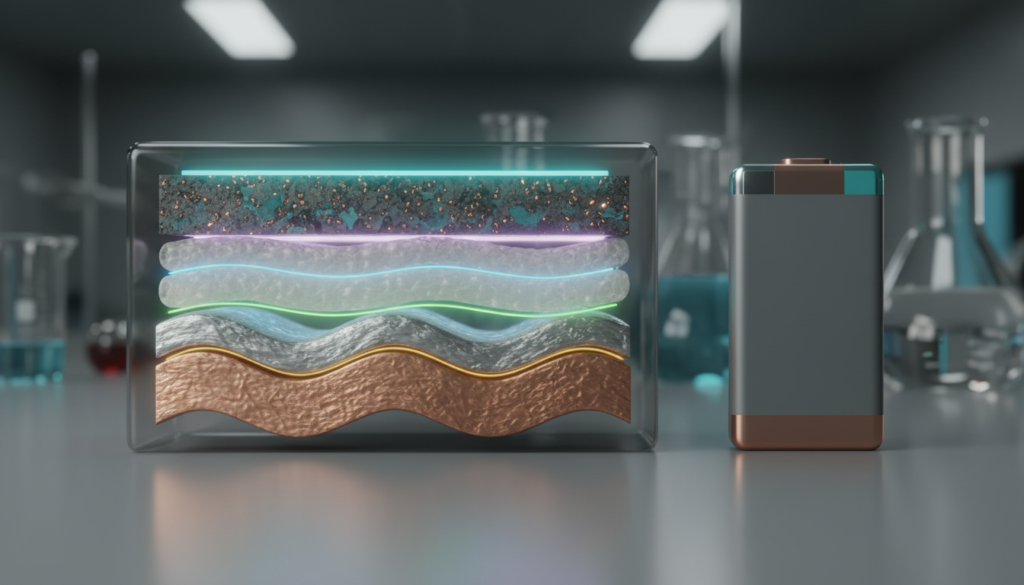
Original DeepTech conceptual illustration. Not a microscopy image, test specimen or battery performance measurement.
A high-energy battery prototype can be encouraging without being a ready-to-buy product. Researchers at the Hong Kong University of Science and Technology (HKUST) reported an initially anode-free lithium-metal battery design with a pouch-cell energy figure of 467 watt-hours per kilogram. In a separate coin-cell experiment, the research team measured approximately 90% capacity retention after 200 cycles. Those two results are real research claims, but they come from different experimental formats and must not be combined into a claim that one commercial-sized battery delivered both outcomes.
HKUST highlighted the results in an institutional report on 23 October 2026. The underlying peer-reviewed paper was actually published earlier, on 25 July 2026, in Nature Communications. We have reviewed the original paper, the university’s account and the institutional research record to keep the timeline and metrics clear.
Image disclosure: the featured image is original DeepTech conceptual artwork illustrating experimental cell layers. It is not microscopy, a photograph of the researchers’ pouch cell or a performance chart.
What does initially anode-free mean?
A conventional lithium-ion cell contains an anode host material, often graphite, that accommodates lithium during charging. An initially anode-free lithium-metal cell instead starts with a current collector, such as copper, and obtains its working lithium from the cathode as the battery is first charged. Removing the starting anode host can reduce inactive mass and make more of the cell’s weight available for energy storage.
This design presents a demanding electrochemical trade-off. Lithium must plate onto the collector and strip away repeatedly, and any irreversible loss reduces the limited inventory of usable lithium. Uneven deposition and unstable interfacial layers can accelerate capacity fade and raise reliability concerns. That is why better energy density in principle does not automatically produce a durable practical battery.
What did the HKUST team change?
The team led by Minhua Shao explored a dynamic integrated interface engineering strategy that uses a multifunctional, silver-based additive in the electrolyte. According to the study, the additive promotes more favorable lithium deposition on the current collector and influences the formation of the protective layer at the electrode–electrolyte interface.
The authors describe a quasi-solid-state interface with differentiated organic-rich and inorganic-rich regions. That interphase is intended to help lithium ions move while limiting harmful changes during repeated plating and stripping. The mechanism proposed in the paper is specific to the tested chemistry; it is not evidence that any silver-containing additive would deliver the same performance in arbitrary battery cells.
What does 467 Wh/kg mean?
The paper reports a two-ampere-hour-class pouch cell with specific energy of 467 Wh/kg based on total cell weight. Specific energy expresses how much electrical energy is available per kilogram of the measured battery system. A higher figure can matter where weight is a constraint, including portable electronics and vehicles.
However, the denominator is essential. Cell-level energy figures are not the same as a complete battery pack with thermal management, protective electronics, housing and interconnects. The reported prototype metric should be compared against other published measurements only when the same mass basis, state of testing and conditions are used. It does not establish that vehicles using the technology would immediately travel a stated extra distance.
Was 90% retained after 200 cycles in that same pouch cell?
No. The original paper reports the cycle-retention result for a Cu||LiFePO4 coin cell tested at 0.1 C. It retained about 90% of its measured capacity after 200 cycles under the reported experimental conditions. The larger pouch cell is associated with the 467 Wh/kg energy measurement. These are complementary pieces of evidence, but they are not interchangeable results from one long-lived full-size cell.
The difference matters commercially. A demanding application might require hundreds or thousands of cycles, faster charging, operation over broad temperatures and a low defect rate across many manufactured units. The existing evidence cannot settle those requirements merely because the coin-cell curve and pouch-cell energy figure both look promising.
Does quasi-solid-state mean the battery is safe?
The researchers’ chemistry may help stabilize the interface and limit problematic deposition, but quasi-solid-state does not mean risk-free. A real safety assessment requires defined abuse tests, thermal characterization, overcharge and short-circuit studies, mechanical behavior and analysis of failure cases. Those should be described independently of energy density and cycle-life metrics.
Likewise, laboratory demonstration of a protective interphase is not yet evidence of production yield, supply-chain cost, recyclable design or regulatory compliance. Our overview of clean-energy technologies discusses how storage systems must pass multiple engineering and commercial tests beyond the chemistry experiment.
What would independent validation require?
A strong follow-up study would replicate the chemistry and test larger batches of cells under predeclared conditions. It should include the exact electrode loading, electrolyte quantity, current rates, temperature range, depth of discharge, mass basis and statistical variability across specimens. Crucially, it should report pouch-cell cycle retention under relevant workloads as well as the separate coin-cell tests.
Reproducible manufacturing and long-term calendar ageing are also important. Investors and engineers need results from cells built with consistent materials and process controls, not merely one high-performing sample. The gap between a verified research result and industrial readiness is explored in our evidence-led guide to deep technology.
The supported conclusion
The HKUST study demonstrates a proposed interface strategy for initially anode-free lithium-metal batteries, with one reported high-specific-energy pouch prototype and separate promising coin-cell cycle data. The paper was published in July and received renewed attention through an October university communication. It has not demonstrated a commercially deployed battery pack combining every quoted result, nor does it prove long-term safety and durability across real customer conditions.
The most valuable next evidence will compare reproducible, larger pouch cells across multiple demanding use cycles. The advance is worth following because its experimental measurements are specific; its limitations are worth stating for precisely the same reason.
Sources and original research
- Nature Communications — Highly stable quasi-solid-state initially anode-free lithium metal batteries enabled by dynamic integrated interface engineering (25 July 2026)
- HKUST — Dynamic integrated interface engineering for lithium metal batteries (23 October 2026)
- HKUST Research Portal — publication, authors and original DOI