MIT WorldParticle Simulates Sand, Fluids and Proteins: What the Tests Show
MIT’s WorldParticle uses one research model to simulate several physical systems. We examine test evidence, speed claims, reproducibility and limits.
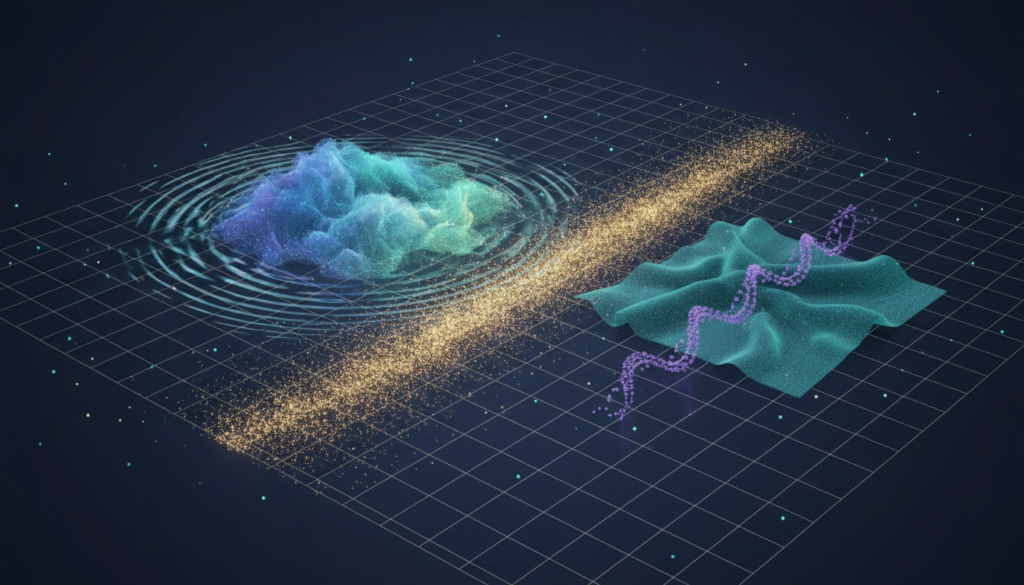
Original DeepTech conceptual illustration. Not an output or measured visualization from the WorldParticle study.
A single artificial intelligence model that can simulate very different kinds of matter is the central claim behind WorldParticle, a research system described by MIT on 9 November 2026. Its developers tested one particle-based learned simulator across phenomena ranging from deformable solids and moving sand to fluid flow and molecular motion. The project is notable because scientific simulation is usually organized around specialized software for each physical regime. But a multi-domain demonstration does not yet mean that one model can replace validated numerical solvers for every scientific problem.
The work involves researchers from MIT, the University of British Columbia and other institutions. It is presented in the MIT research account of 9 November, accompanied by a project page with examples and evaluation details and a public code repository. These sources allow readers to distinguish what was tested from the broader applications the authors envisage.
Illustration disclosure: the featured image is original DeepTech conceptual artwork of several simulated materials. It is not an authentic result frame from the WorldParticle experiments.
Why a unified simulator matters
When engineers analyze a falling pile of grains, a moving liquid or a bending piece of cloth, each material has different governing properties. Conventional simulators often encode those differences using tailored equations, discretization methods and numerical solvers. Such tools can be extremely reliable within their specified assumptions, but combining several interacting substances in one scenario may be challenging and computationally expensive.
Learned simulators offer another approach: they use examples of motion to predict how a scene evolves over time. The objective is not to discard physical science, but to approximate useful behavior sufficiently well for a defined task and set of conditions. A successful simulator must preserve plausible motion over repeated predictions rather than merely generate one convincing frame.
What the WorldParticle research evaluated
The MIT report says the team evaluated WorldParticle over six kinds of physical phenomena, including deformable objects, granular material and proteins. The project page shows cloth interacting with objects, liquids with different viscosities, granular collapse under varying friction and elastic materials under changed configurations. These examples support the claim that one research model can be applied across distinct kinds of particle trajectories.
According to the team, WorldParticle reproduced several test behaviors more accurately than selected comparison approaches. In one example discussed by MIT, a granular pile settled plausibly while certain baseline predictions left particles suspended. Such comparisons are relevant, but the result depends on the chosen baselines, datasets and evaluation metrics. It is not an independent proof that the learned system is superior to every established solver.
What the reported speed result does — and does not — prove
The MIT account reports that the system modeled changes in protein structure about 100 times faster than a numerical-simulation comparison in the researchers’ setup. This is a task-specific reported speed result, not a universal statement about all molecular-dynamics workloads. An appropriate comparison must account for accuracy, hardware, simulation duration, training cost and whether a physical system differs from the training distribution.
Faster approximate trajectories may be particularly valuable for screening questions or exploratory work. But a model used to predict a drug-related protein interaction would need separate scientific checks before a biological conclusion could be trusted. Rapid simulation is not equivalent to experimental validation.
What do unseen configurations tell us?
The public project page describes examples in which test scenes have different geometries, fluid volumes, friction values or actuation strengths from the training examples. It also reports stable predictions in selected extended rollouts, including up to 800 rollout steps in one fluid experiment and a cloth-actuation demonstration beyond the training horizon. These are useful signs of generalization inside the evaluated simulation families.
They do not prove unlimited extrapolation to entirely new materials, rare extreme events or long-duration industrial operation. Error can compound during autoregressive simulation, especially when the model repeatedly consumes its own previous predictions. The number of rollout steps also should not be confused with a number of seconds or a physical distance without the associated simulation timestep.
Why open research artifacts matter
The code repository includes configuration files, data-loading components, inference entry points and implementation files. That improves transparency around the reported work and may help researchers attempt reproduction. However, the existence of a repository does not establish that every dataset, computational resource, trained checkpoint or experimental result can be recreated without additional setup.
A strong independent reproduction would freeze the model and evaluation conditions, document the held-out scenarios and compare numerical errors and runtime on the same hardware. It should also report failure cases, not merely visually successful videos. This distinction between published examples and reproducible evidence is central to our guide to independent AI testing.
Where the approach could be useful
The research team suggests applications including designing soft robots and exploring molecular behavior. A robotics designer, for example, might want to examine how a deformable object moves when grasped. A materials scientist may need quick approximations of different responses before choosing more expensive simulations or laboratory tests. These scenarios are plausible motivations, not yet commercial deployments demonstrated in the public research.
The technology also belongs to a larger shift in scientific computing: combining data-driven approximations with conventional measurement, numerical methods and physical assumptions. For perspective, our DeepTech evidence-to-market overview explains why a laboratory capability can require substantial additional validation before product adoption.
What remains unproven
WorldParticle has demonstrated a research-level attempt at unified particle-based simulation with comparative tests and openly visible supporting artifacts. The available sources do not establish reliable prediction in arbitrary physical systems, clinically validated protein simulations or replacement of every specialized solver. Relevant next steps include independent benchmark reproduction, broader failure analysis, controlled hardware comparisons, uncertainty assessment and demonstration in a defined real engineering workflow.
The important result is therefore specific: one trained simulator handled several selected kinds of physical motion within the researchers’ experimental framework. Its value outside those conditions should be measured, not inferred from the breadth of an impressive demonstration.