Enterprise AI Agents: Security, Costs and a Practical Deployment Checklist
An evidence-led enterprise AI agent deployment guide covering tool permissions, workflows, costs, risk controls, procurement and pilot acceptance criteria.

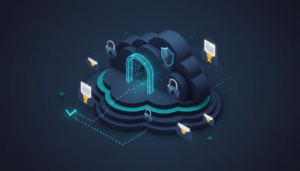
Original DeepTech conceptual illustration; not an actual enterprise software interface.
Enterprise AI agents are software systems that can pursue a defined business objective by combining model outputs, application tools and workflow steps. They can retrieve information, prepare drafts, update records or request actions through connected business services. Unlike a standalone chatbot answer, an agent workflow may have operational consequences. This guide explains what companies should evaluate before buying or deploying an agent platform, with concrete security, cost and pilot checks rather than unsupported promises of productivity.
A software subscription described as enterprise SaaS is typically a hosted service designed for organizations rather than an individual consumer account. For an AI agent product, the procurement decision needs more than a polished demonstration. Organizations must examine identity and permissions, available integrations, failure handling, data retention, auditability, operating cost and the ability to stop an unsafe action. The NIST AI Risk Management Framework and the OWASP agentic AI risk guidance are useful sources for framing that assessment.
Editorial method: this is an original comparison framework based on published technical and standards guidance, not a hands-on ranking of vendor products. The featured image is original conceptual artwork, not a software screenshot.
What qualifies as an enterprise AI agent?
An agent generally receives a goal, chooses or follows a sequence of steps and interacts with tools or data sources. A simple workflow may categorize an incoming ticket and draft a response; a higher-risk agent might alter customer records or trigger a financial transaction. Products use the word “agent” loosely, so buyers should request a demonstration of actual inputs, permissible actions, approvals and outputs. A chatbot that only writes suggested text is not operationally equivalent to a service that can execute changes in production systems.
Integration is often the decisive feature. Can the product connect to a customer relationship management system, ticket queue or internal document store? Does it enforce the existing user’s entitlements? Can it run with read-only access? A large catalogue of connectors is less useful if audit logs and access boundaries are unclear.
What security boundaries should be mandatory?
OWASP recommends least-privilege tool access, validation of external content and human review for high-impact actions. That matters because an agent can encounter malicious instructions embedded in a document, search result or message. It should treat such material as untrusted task data rather than as authority to expand its permissions. Agent software should also separate one customer’s secrets, context and records from another customer’s data.
An enterprise deployment should distinguish the model’s suggested action from the authorization service that permits execution. For example, a model may propose deleting a record, but a separate policy gate should reject the operation unless the authenticated user has the right permission and a required approval is present. Logs should include who requested an action, which tool was called, the resulting status and an appropriate reference to the source without recording secrets in plain text.
How should costs be compared?
Price comparisons are more useful when they describe the actual business workflow rather than the vendor’s cheapest advertised tier. Costs may include seat subscriptions, per-run fees, model inference or token usage, search and vector storage, external API calls, human review, integrations, infrastructure, support and compliance overhead. Some platforms use consumption pricing; others offer fixed packages. Neither model is automatically cheaper.
A buyer can calculate cost per completed, accepted task by dividing the pilot’s total operating cost by the number of tasks that pass its acceptance rules. Separately track the percentage requiring human correction and the cost of incidents. A workflow may look economical per API call but become expensive when retries, errors or manual verification are counted. Our enterprise AI observability guide sets out the telemetry needed to measure those costs.
Which workflows should be piloted first?
Start with bounded, reversible tasks for which a reviewer can quickly recognize success or failure: drafting a service reply for human approval, extracting fields from consistent documents, or identifying missing information in a purchase request. Avoid starting with unrestricted account administration, irreversible payments or autonomous clinical decisions. A small pilot should have a fixed input set, a defined action scope, an error classification system and a fallback to existing processes.
For each case, specify what counts as a successful task, what must be escalated and what is prohibited. Include genuinely unseen requests rather than tuning the system only on examples repeatedly used during development. A frozen protocol and independent review are more informative than selecting the best output from multiple attempts. See our independent AI validation guide for how to record reproducibility, error cases and limitations.
What evidence should an enterprise vendor provide?
Request a data-flow diagram, list of sub-processors and hosting regions, authentication and role model, retention and deletion policy, incident response commitments, service availability objectives, human-approval configuration and logs of actual test runs. Security attestations may be useful, but a document alone cannot establish that a particular agent workflow is safe. The scope and date of any report matter.
Insist on reporting false actions, unauthorized tool-call attempts, prompt-injection outcomes and timeouts alongside successful runs. For a multi-step workflow, measure the proportion of complete end-to-end tasks rather than averaging scores for unrelated intermediate components. Buyers should also ask how the system behaves when a data source is unavailable or returns contradictory information.
A practical six-part pilot checklist
- Define one business outcome, a representative workload and the maximum permitted actions.
- Fix the tool permissions, approval gates, data boundaries and rollback process before testing.
- Freeze the workflow and acceptance criteria, including disallowed and ambiguous cases.
- Measure task completion, error severity, human-review time, latency and cost per accepted task.
- Test adverse scenarios: malicious documents, expired permissions, incomplete inputs and tool outages.
- Publish a signed pilot report with decisions, known limitations, owners and next steps.
How do agents fit into the wider enterprise technology stack?
Agent software is only one layer of enterprise operations. Reliable deployments require security assurance, performance telemetry and integration with existing systems. Our companion articles cover SOC 2 and ISO 27001 assurance questions for AI SaaS, industrial digital twin software evaluation and predictive maintenance AI pilots. They are different purchase decisions, but the same principle applies: evaluate observed outcomes under defined conditions before scaling.
For organizations considering agent systems in 2026, the strongest case is neither “AI replaces everyone” nor “never use autonomous software”. It is a narrower, verifiable decision: determine what the system may do, which failures are acceptable, what the deployment will cost and how a real customer can audit its performance.
Architectural context: Enterprise AI agents operate within a broader production architecture that includes access controls, observability, security assurance and financial evaluation. Explore our Enterprise AI Deployment Guide for an integrated assessment of these requirements.