Industrial Digital Twin Software: A Practical Guide for Manufacturers
A practical buyer guide to industrial digital twins, drawing on NIST research about model validation, integration, security and cost.
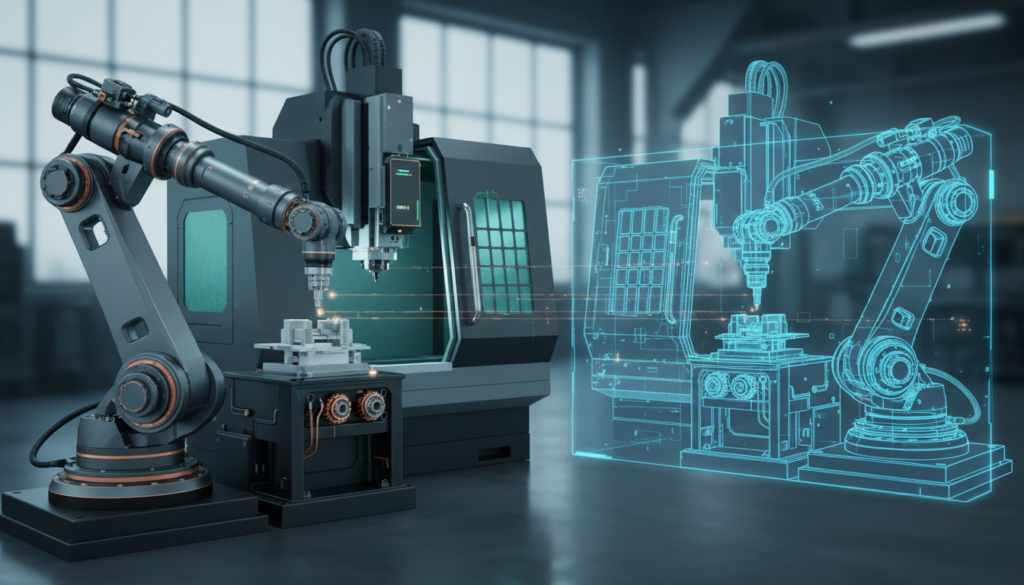
Original DeepTech conceptual illustration; not a rendering from a factory or a vendor's digital twin.
Industrial digital twin software represents some aspect of a physical asset or production process in a digital environment and connects that representation with real-world evidence. Manufacturers may use it for throughput planning, maintenance scenarios and equipment design. But a beautiful three-dimensional model is not necessarily a trustworthy twin. A credible procurement decision needs documented data flows, calibration, uncertainty estimates and an outcome that can be measured independently of the software vendor’s visual demonstration.
For a practical evaluation framework, two useful primary sources are the NIST 2026 Digital Twins Workshops Summary Report and the 2026 NIST AI and machine learning roadmap for smart manufacturing. Both address deployment barriers including interoperability, model verification and validation, data management and security. The guidance below translates those concerns into questions a buyer can ask before signing a subscription or integrating a platform into a plant.
Editorial note: this is original explanatory analysis based on research and standards documentation; it is not a ranking based on hands-on vendor testing. The featured image is conceptual artwork, not a real industrial installation.
What makes a digital twin different from a simulation?
A standalone simulation estimates how a system may behave under selected assumptions. A digital twin generally also relates the model to a defined real asset or process through measured information and an update procedure. Some twins use continuous sensors; others update periodically. The required frequency depends on whether the decision concerns second-by-second operations, daily planning or occasional engineering changes. A model is useful only if its assumptions and accuracy match the decision for which it is intended.
Ask the vendor to identify the physical asset, sources of data, update frequency, version of the model and outcomes the system claims to predict. A platform with attractive rendering tools but no validated link to relevant physical measurements may still be good engineering software — it simply should not be purchased on unsupported claims of predictive accuracy.
Begin with a measurable factory problem
Different factories have different constraints. One plant may want to compare conveyor layouts, another may study energy use and a third may need to detect recurring equipment faults. These objectives call for different measurements and modelling detail. Start by specifying a decision that currently costs time or money, then define the evidence that a twin must improve over the existing process.
For instance, reducing queue times at a workstation requires production timestamps, process variation and a meaningful baseline. Improving repair scheduling needs component history and condition measurements. A pilot without a target decision can produce a compelling demo but little evidence of operational benefit.
What data integrations matter?
Industrial sites often use combinations of sensors, controllers, equipment historians, manufacturing execution systems and enterprise planning software. A digital twin needs the correct values, timestamps, physical units, equipment identifiers and permissions. If sensor values are missing or clocks disagree, simulation outputs can be confidently wrong. Data quality should be assessed before teams interpret model outputs as the state of the real factory.
Ask about import and export formats, documented industrial interfaces and mechanisms for migrating data and model assumptions. Such openness may reduce lock-in, although standardized interfaces alone do not ensure two software products share the same semantics. Buyers should also consider how the system handles hardware upgrades or changes to production recipes.
What must verification and validation demonstrate?
Verification asks whether an implementation follows its specified mathematical or computational method. Validation asks whether that model predicts real behavior accurately enough for a particular application. The NIST 2026 workshop report identifies verification, validation and uncertainty quantification as important barriers. A manufacturer should request evidence from held-out operating periods or controlled changes not used to tune the digital model.
Report errors with meaningful units, confidence ranges where justified and conditions under which the model fails. Do not infer reliability just because simulated machinery appears to move correctly on the screen. If model outputs influence expensive or safety-critical decisions, independent checks and operator oversight become more important.
Is cloud SaaS the right deployment model?
Cloud-hosted twins can make updates and collaboration easier, while on-premises systems can support local operation and stronger control of specific data paths. Hybrid arrangements are also possible. The relevant comparison includes network availability, latency, data-residency rules, operating cost, support obligations and what happens when the service is unavailable. There is no universal winner.
Subscription price is only one element of total cost of ownership. Model creation, sensor installation, data cleansing, engineering support, staff training, platform integration and long-term maintenance may dominate the initial contract. Buyers should include an exit path for exporting data and preserving usable models if they change suppliers.
What security boundaries are essential?
A digital twin may observe industrial operational technology, and some platforms can also send commands back to equipment. Separate read-only monitoring from write-capable control. Use least-privilege credentials, network segmentation, human approval for consequential changes and documented rollback procedures. Never assume that a dashboard can safely take control of a production asset simply because its visual representation is convincing.
Review the platform’s protection of process data, engineering designs and credentials. Confirm retention settings, audit logs and who can share models externally. These controls become especially relevant when a hosted SaaS environment combines information from many facilities or suppliers.
A six-step digital twin pilot
- Choose one physical asset or process and specify one measurable business decision.
- Document sensor quality, data ownership, integration scope and the comparison baseline.
- Freeze the model configuration and test it on observations outside the tuning period.
- Measure error, uncertainty, decision usefulness and operational effort.
- Exercise missing-data, connectivity-failure and unauthorized-action scenarios.
- Compare full cost, exportability and maintenance needs before scaling.
How this differs from predictive maintenance software
A digital twin may support maintenance, but a facility can also implement useful condition monitoring without constructing a detailed digital replica. Predictive maintenance software is judged by the usefulness of warnings and resulting repairs; a twin may add broader process scenarios, simulation and asset interaction models. Our predictive maintenance AI buyer guide describes the relevant false-alarm, missed-failure and economic measures.
A reasonable procurement decision asks which model detail is necessary for the task, whether the operating evidence is trustworthy and how the vendor demonstrates a clear advantage. This fits the research-to-deployment distinction in our DeepTech evidence and commercialization guide. Industrial buyers should be able to trace every important claim to a reproducible observation or qualified engineering assumption.
Architectural context: Industrial digital twins depend on reliable data integration, validated models and appropriate boundaries between monitoring and physical control. See how these requirements relate to broader enterprise technology decisions in our Enterprise AI Deployment Guide.