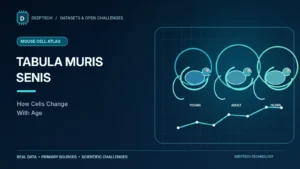
Tabula Muris Senis: What Mouse Cells Reveal About the Biology of Ageing
Why does ageing affect some cells and organs differently from others? Tabula Muris Senis, a large-scale mouse ageing atlas, provides experimental cell measurements that allow researchers to investigate this question with
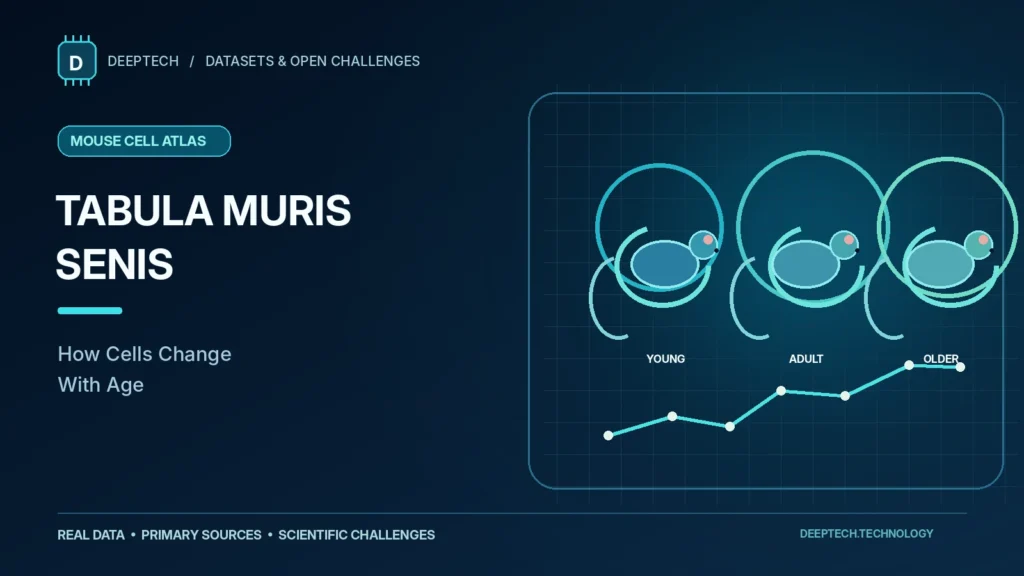
Original conceptual editorial illustration for DeepTech; not actual research data or experimental microscopy.
Why does ageing affect some cells and organs differently from others? Tabula Muris Senis, a large-scale mouse ageing atlas, provides experimental cell measurements that allow researchers to investigate this question with a level of detail unavailable from averages alone.
Which Tabula Muris record is relevant?
The phrase Tabula Muris describes a family of mouse cell-atlas resources, rather than one interchangeable download. The GEO GSE149590 entry is titled Tabula Muris Senis and describes single-cell processed records for 18 tissues and organs, with droplet and FACS/Smart-seq2 data. It belongs to the broader GSE132042 super-series, which includes other related sequencing projects.
This is a useful illustration of provenance risk: the published Nature article discusses a wider experimental atlas, while a particular repository sub-series may cover a narrower set of materials. A reader should name exactly which accessions, sample groups and assay types were downloaded before comparing numbers across a paper and a database.
A real experiment, not a human rejuvenation simulation
The Nature study A single-cell transcriptomic atlas characterizes ageing tissues in the mouse, published in July 2020, analysed gene-expression data from cells in 23 mouse tissues and organs across the animals’ lifespan. It combined complementary laboratory approaches for measuring single cells.
The study reports age-related differences within cell types and changes in the proportions of different cell types. Its origin is biological sampling and sequencing, not computer-generated patient records. That distinction matters: real measurements support the analysis, but mouse biology is not automatically equivalent to human biology.
What the study actually found
Researchers identified both tissue-specific and shared molecular signatures associated with ageing. The study examined hallmarks such as senescence, genomic instability and immune-system change. Some patterns can be seen across organs, while others depend on particular tissues or cell types.
Independent analysis can ask whether a reported pattern persists after technical effects, differences in cell sampling and batch variations are considered. Age-related association alone does not establish which biological change causes another.
Could this help future therapies?
Data of this type may help scientists decide which molecular pathways deserve further investigation, which tissues show early ageing-associated changes, and how experimental interventions might be evaluated later. A target discovered from an atlas can become a hypothesis for laboratory follow-up.
Showing that a gene changes with age is not the same as proving that altering it reverses ageing, extends life or treats an age-associated disorder. Before any human medical claim, researchers would need appropriate independent, functional and clinical evidence.
Five possible independent challenges
- Reproduce a published cell-type ageing signature using only documented raw data.
- Test whether the same signature holds in other organs or experimental batches.
- Quantify the effects of sparse sampling and unequal numbers of cells.
- Compare separately collected animal datasets without leaking test information.
- Separate uncertainty in annotations from uncertainty in biological interpretation.
Find the experimental data and paper
The official Nature article links to public data, including GEO accession GSE149590 (Tabula Muris Senis processed data) and Figshare gene counts and metadata. The Nature paper cites GSE132042, the wider Tabula Muris super-series. GSE149590 is the dedicated Tabula Muris Senis processed-data sub-series, and both records are legitimate but have different scopes.
This resource is a substantial challenge for reproducible biology, not evidence of a demonstrated human rejuvenation treatment. More resources appear in our Datasets directory.
A reproducible ageing comparison, step by step
For a concrete challenge, select a single organ that appears across several age groups, then fix the gene-count processing and filtering criteria. Estimate the ageing-associated expression pattern at the level of the individual animal, not by treating thousands of cells from one mouse as independent mice. Record each animal’s age, sex where available, tissue, assay platform and sample preparation. The most informative test would ask whether the pattern survives an analysis on withheld animals or a distinct experiment.
- Sampling: report the number of animals as well as the number of measured cells
- Method: do not directly compare droplet and FACS-based estimates without considering technical differences
- Analysis: distinguish a changing cell-type proportion from a changing expression level within the same cell type
- Translation: treat observed mouse-age patterns as biological leads, not evidence of a treatment for human ageing
A negative replication could still be informative, because it might identify a fragile annotation, a tissue-specific effect or an age-related pattern driven by sampling. This article reports published research only; DeepTech has not independently reanalysed the single-cell files.