AI Agents in Biology: 32 Minutes of Brain-Cell Analysis Is a Lead, Not a Cure
AI agents analyzed existing mouse brain-cell data in 32 minutes. The research may speed hypothesis generation, but it does not establish a treatment for disease.
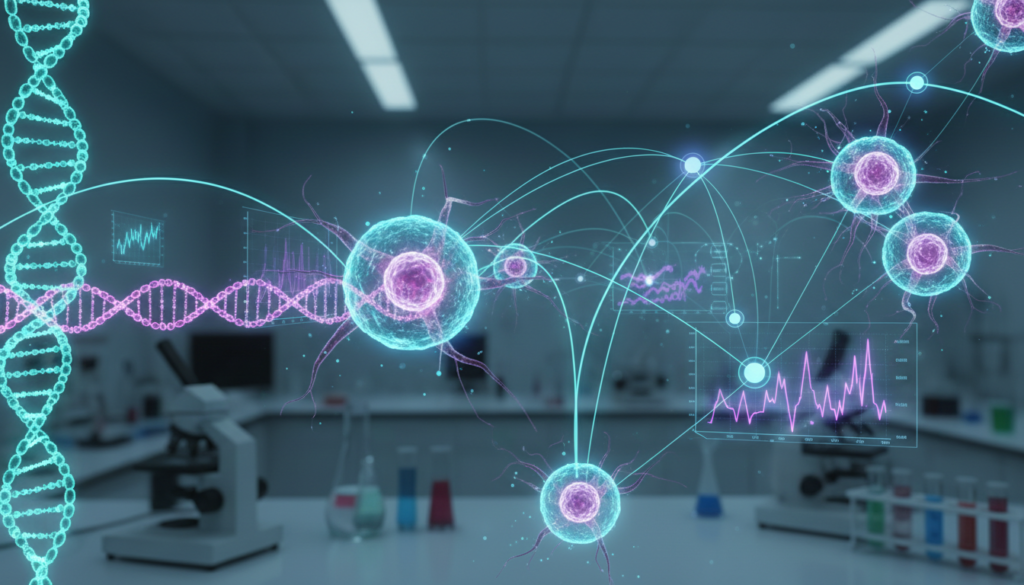
Original conceptual illustration for DeepTech; not a documentary photograph or screenshot.
AI agents in biology are beginning to assist with one of research’s slowest jobs: connecting large experimental datasets to plausible scientific explanations. On 21 October 2026, OpenAI described a collaboration with PerturbAI and Scripps Research in which thousands of AI agents examined data from millions of mouse brain cells in 32 minutes. The result was a map of potential biological relationships and research leads, not a new drug, clinical trial or cure.
What did the biology agents actually analyze?
The project used an existing whole-brain CRISPR atlas, a dataset that records how disrupting particular genes is associated with changes across different types of brain cells in mice. Different agents investigated different gene perturbations, examined the associated cellular responses and consulted scientific literature. The output was then assembled into a reference linking possible effects to candidate explanations and supporting publications.
This matters because the interpretation of a large cell atlas can consume considerable researcher time. A vast measurement collection is not automatically an explanation: investigators still need to identify credible relationships, rule out misleading associations and decide which claims are worth testing. The work attempted to accelerate that first layer of interpretation.
Why is the 32-minute result interesting but limited?
The team reports that its large group of AI agents completed a parallel analysis in 32 minutes. It compared the process with a human analysis and literature-review workload that it estimated could take months or longer if examined sequentially. Those are not directly equivalent operating conditions. Wall-clock time for a computing system also does not include the time needed to collect the original experimental data, design the analysis or validate the hypotheses it produces.
According to the collaborators, the generated assessments recovered relationships familiar from human analysis and surfaced additional candidate leads. They also reported alignment between some novelty assessments and blinded expert judgments. These observations are useful, but a generated explanation remains a hypothesis until biological experiments test its prediction.
Can these AI findings already be applied to Alzheimer’s or Parkinson’s disease?
No clinical effect is established by this experiment. Connections to neurological conditions can help scientists prioritize future study, but the dataset involved mouse brain cells and genetic perturbations. Evidence about mouse cellular responses does not prove that a given mechanism operates identically in people, much less that acting on it can treat a disease.
Readers should separate three levels of evidence: measured cell responses, AI-generated interpretations, and independent experimental confirmation. Only the first is directly present in the underlying dataset. The second is what the agents produce. The third remains the necessary next step for the specific leads being proposed.
What would an independent validation look like?
Researchers could preregister a set of biological predictions derived from the agent analysis, freeze those predictions and then test them in new experimental data, ideally with teams that did not select or tune the original leads. The results should include unsuccessful predictions and the full cost of running and reviewing the analysis. This would help distinguish an effective prioritization tool from a system that merely generates compelling narratives.
The broader question resembles the one discussed in DeepTech’s article on independent AI validation: a convincing output is not the same as an independently demonstrated result.
Why this could matter to research groups
Even without producing direct medical breakthroughs, faster literature-linked analysis could give scientists more time to design experiments and evaluate difficult cases. But biomedical research requires traceability, careful uncertainty management and human review because false positives can waste laboratory resources. Better speed is valuable only if the follow-up work can separate promising leads from mistakes.
Primary source and scope
• OpenAI, PerturbAI and Scripps Research — official report, 21 October 2026.
Editorial note: This article reports publicly described research on existing mouse-cell data. It does not offer medical advice or claim independently validated clinical outcomes. Featured image: original conceptual illustration.