How MIT’s Robot Memory System Corrects AI Errors
MIT robot memory research examines how robots correct uncertain object descriptions. Explore reported findings, limitations and independent validation needs.
Research briefing · 5 November 2026. Please note that this informative news article serves specifically to report empirical findings previously announced by the Massachusetts Institute of Technology; therefore, it does not claim to provide independent replication or verification of the stated data.
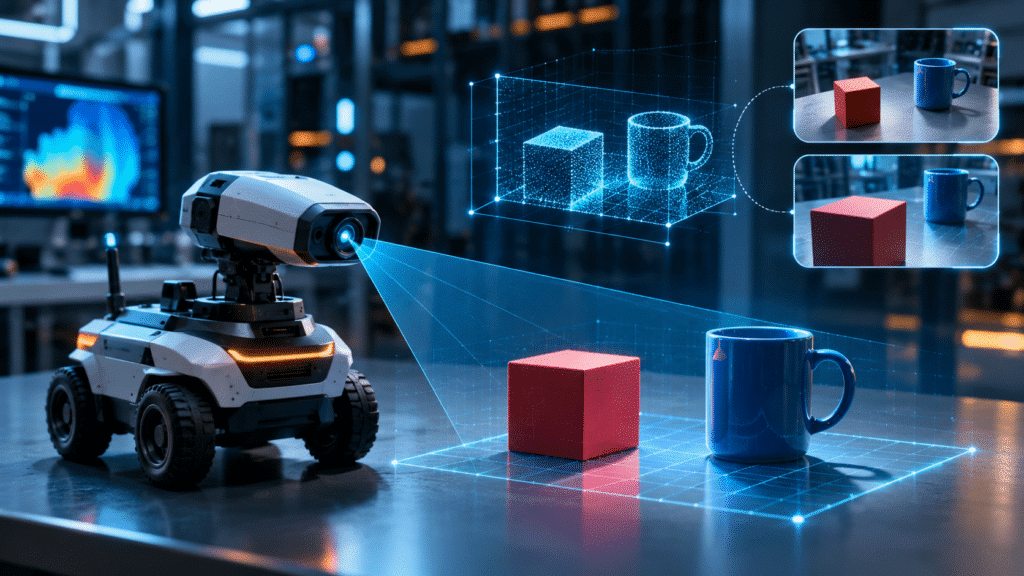
MIT robot memory research examines how machines can recall what they saw, where they saw it and when. When a robot explores a room, it does more than record images. To answer questions later, it needs to connect what it saw with where and when it saw it. A blurry view, a partially hidden object or a misleading description can leave an error in that memory. A research team at the Massachusetts Institute of Technology has reported a method designed to detect and revise unreliable descriptions rather than simply preserving them.
The research and the practical problem
In a report published on 5 November 2026, MIT described a system called UQ-DAAAM, short for Uncertainty Quantification for Describe Anything, Anywhere, at Any Moment. The work builds on an earlier robot-memory framework described by MIT in June 2026. The new research focuses on recognising when an object’s stored description might be unreliable and using other observations to improve it.
This matters because a robot may need to retrieve an object or answer a question about its surroundings long after the first observation. A mistaken description can become a persistent operational problem if the machine never revisits its earlier conclusion.
MIT robot memory study: methods and results
According to MIT’s account, the system evaluates the uncertainty associated with descriptions and draws on observations of the same object from different viewpoints. MIT reports that its refinement process resolved ambiguity for approximately 92% of objects under the study’s evaluation conditions, using two additional captions per object, and improved object-description accuracy by five percent compared with the reference approach.
The framework combines a vision-language model for scene descriptions with a language model to consolidate selected captions. These are research results in a defined experimental setting, not evidence that robots can now operate without errors in every home, hospital or industrial environment. Performance on unknown layouts, different cameras and time-critical tasks must be evaluated separately.
What the MIT result does and does not prove
A robot’s statement can sound precise even if the image behind it is ambiguous. A useful system therefore needs evidence about what it observed, a way to report uncertainty, and an opportunity to revise an answer when better observations are available. That requirement is broader than robotics: it applies wherever an AI-generated description may guide a consequential physical action.
The study also illustrates a distinction between correcting an uncertain observation and guaranteeing correctness. Even when a memory entry becomes more reliable, that does not prove the downstream action will be safe. End-to-end tests remain necessary.
Five independent tests that would strengthen the evidence
- Evaluation in new buildings or environments not used during development.
- Measurements of wrong-object retrievals, missed objects and false corrections.
- Latency and energy use on actual hardware, not just answer accuracy.
- Independent replication of the reported comparisons.
- Explicit reporting of the cases in which correction fails.
These are proposed evaluation criteria, not tests that this publication claims have already been completed. For an introductory overview of the broader field, see our article on the practical limits of humanoid robots.